
Reviewed · WALKING TOURS
Tbilisi by Night Walking Tour
Tbilisi looks made for evening walks. This three to three-and-a-half-hour tour links the Old Town, the Kura River, Narikala Fortress, Abanotubani, and Mtatsminda in one outing. I like the mix of major sights and small cultural details, especially the Berikaoba folk theater story and the angel clock at Rezo Gabriadze’s theater. I also like that a guide shares advice on Georgian food and places to drink at the end.
The main thing to consider is the pace. You cover a lot of ground on foot, with the route moving from the Old Town up toward the hills before finishing at the funicular station. Comfortable shoes are essential, and the one-way cable car ride is included, but the funicular ride is not.
In This Review
- Key points to know before booking
- Starting with Berikaoba and Tbilisi’s old stories
- Rezo Gabriadze’s clock tower and the 7 pm show
- Anchiskhati Basilica and the Baratashvili Bridge
- Crossing the illuminated Bridge of Peace
- Narikala Fortress and the Rike-Narikala cable car
- Botanical Garden, Jumah Mosque, and Leghvtakhevi Waterfall
- Chreli Abano and the best all-in-one photograph
- Liberty Square and the final climb toward Mtatsminda
- What the $72.25 price gets you
- Who will enjoy this evening tour most
- Should you book Tbilisi by Night?
- FAQ
- How long does the Tbilisi by Night Walking Tour last?
- What time does the tour begin?
- Where does the tour begin?
- Where does the tour end?
- Is the cable car included?
- Is the Tbilisi Funicular included?
- Is food included?
Key points to know before booking
- The route covers two great viewpoints: You see Tbilisi from the Rike-Narikala cable car area and from Mtatsminda’s observation deck.
- The tour begins at 7:00 pm: This gives you a useful mix of fading daylight and fully lit city sights.
- The group is limited to 15 people: That is small enough for questions and help with photos.
- The one-way cable car ride is included: The round-trip funicular at the end is not included.
- The route blends landmarks with local culture: You hear about Berikaoba, the sulfur baths, the mosque, churches, and Georgian city life.
- Guide quality matters: Anya received especially warm praise for her personal approach, while Zora was praised for giving first-time visitors a strong introduction.
Starting with Berikaoba and Tbilisi’s old stories
The meeting point is beside the Berikaoba sculpture group, identified by the map code MRW4+HPC in Tbilisi. This is a good opening point because the tour does not begin with a list of dates and rulers. Instead, you start with a piece of Georgian folk culture.
Berikaoba grew from a pagan fertility and rebirth celebration and took the form of improvised masquerade theater. The sculpture group gives your guide a chance to explain how performance, masks, and public celebrations fit into Georgian culture. It is a short stop, about 10 minutes, and there is no admission charge.
I like this beginning because it gives the evening a local frame. You are not simply checking off monuments. You are learning how Georgians expressed stories and beliefs in public spaces.
The guide is an important part of this first stop. Anya was praised for her warmth and detailed knowledge of Tbilisi, while Zora was singled out for making the city approachable to first-time visitors. The group may be led by a multilingual guide, and the tour is offered in English.
More walks:
- Tbilisi Walking Tour Including Cable Car and Traditional Bakery
★ 5.0 · 1,310 reviews - Tbilisi:Evening Walking & Talking Tour with Wine & Boat Ride
★ 5.0 · 572 reviews - Old Tbilisi Highlights walking tour with wine & 10 tastings
★ 5.0 · 276 reviews
Rezo Gabriadze’s clock tower and the 7 pm show
From Berikaoba, the walk toward the Rezo Gabriadze Marionette Theater takes about 20 minutes. The theater’s clock tower was built in 2010 and has become one of Tbilisi’s most recognizable small landmarks.
Each hour, an angel comes out to ring the bell. If your timing works, you can also see the small 7 pm performance called The Circle of Life at the puppet theater and clock tower. The stop is listed as about 30 minutes and admission is free.
This is one of the most distinctive moments on the route. It is easy to pass a clock tower, snap a photo, and move on. The guide adds value by explaining the theater and the artistic idea behind the clock.
There is one practical point here: the 7 pm show may not line up perfectly with every tour departure or group pace. Since the tour begins at 7:00 pm, ask the guide at the start if seeing the performance is part of your evening plan. The clock itself remains worth seeing even if you miss the small show.
Anchiskhati Basilica and the Baratashvili Bridge
As you continue through the Old Town, you pass the illuminated Anchiskhati Basilica of St. Mary. It is described as the oldest surviving church in Tbilisi and dates from the sixth century.
The stop is brief, but the church helps explain how old Tbilisi is beneath its modern lights. The evening setting also gives the building a quieter presence than it might have during a packed daytime sightseeing circuit.
The route then reaches Baratashvili Bridge, built in 1966 on the site of the earlier Mukhrani Bridge. The bridge honors Princess Mukhrani, and the tour pauses at a viewpoint for photographs of the Old Town.
Allow about 20 minutes for this part, followed by another walk of around 15 minutes. This is a good chance to take pictures without rushing, although the number of stops means you should keep your camera ready rather than waiting for a long photo session at every location.
Crossing the illuminated Bridge of Peace
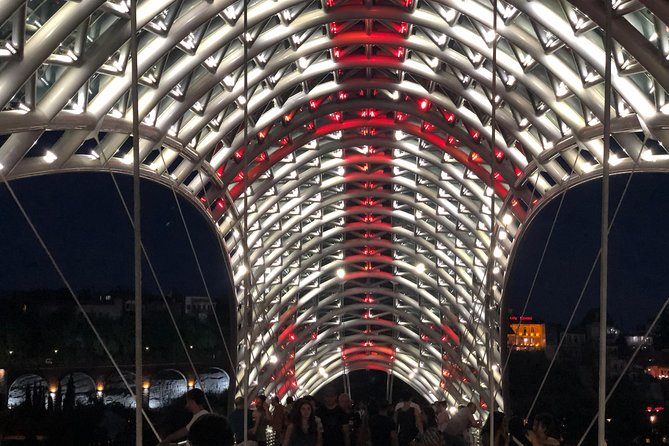
The Bridge of Peace is one of modern Tbilisi’s most striking night scenes. Its steel and glass structure crosses the Kura River and is lit by numerous LEDs.
You spend about 30 minutes walking around this area. The bridge gives the tour a useful change of mood. Earlier stops focus on old churches, folk customs, and the historic center. Here, the city feels more recent and deliberately modern.
I like having both sides of Tbilisi in one evening. You get the tiled roofs and narrow streets of the Old Town, then the bright contemporary design of the bridge. If you prefer old buildings only, this section may feel less essential, but it helps you understand the city’s changing character.
A few more ways to spend a day out of Tbilisi
- Batumi Guided Night Walking Tour With Welcome Drinks
★ 5.0 · 16 reviews
Narikala Fortress and the Rike-Narikala cable car
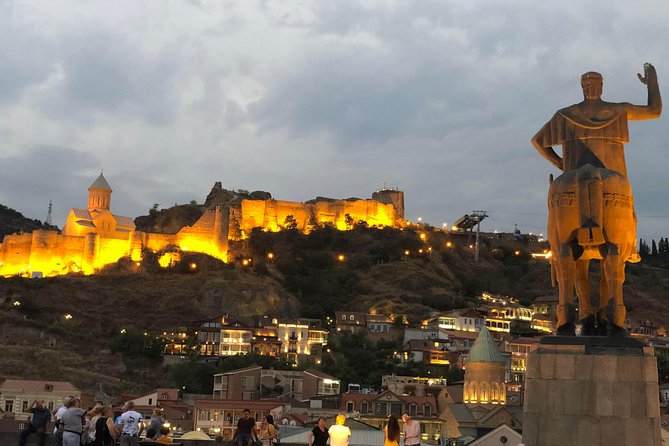
The tour continues toward Narikala Fortress, which is lit at night. Your guide explains its historical importance and architecture while you look toward the fortress from the surrounding area.
The fortress is one of Tbilisi’s defining sights, but the evening visit is more about atmosphere and broad views than a detailed exploration of every wall. The walk around this section takes about 20 to 30 minutes.
From the lower station, you take the Rike-Narikala cable car uphill. The one-way ride is included in the price, and the trip gives you a quick view over the Old Town and the river. The entire movement to the next area, including walking and time around the stop, is listed at about 50 minutes.
The included cable car is an important value point. It saves you from covering the full uphill connection on foot and adds a memorable transport experience to an otherwise walking-heavy evening. Keep in mind that only one way is included, and the cable car is not a private vehicle.
Botanical Garden, Jumah Mosque, and Leghvtakhevi Waterfall
From the hill area, your guide points out the National Botanical Garden of Georgia. The garden lies in the Tsavkisis-Tskali Gorge on the southern foothills of the Sololaki Range.
You do not get a full botanical garden visit on this tour. Instead, you receive context about its position and significance as you move through the city.
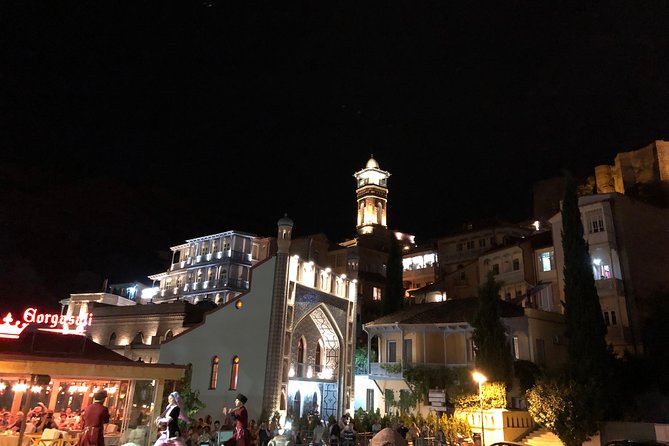
The route also passes the Jumah Mosque, lit after dark. It is notable because Sunni and Shia Muslims pray side by side there. That detail gives the evening a human and cultural focus, showing Tbilisi as a city where different religious traditions meet within a compact historic center.
Next comes Leghvtakhevi Waterfall, surrounded by cliffs in central Tbilisi. At night, the lighting gives the waterfall a different feel from a daytime visit. The stop is short, around 10 minutes, so think of it as a focused photo and atmosphere break rather than a long walk through the area.
The changing terrain is part of the appeal, but it also explains why shoes matter. You move through streets, bridges, hill areas, and the waterfall district in one outing. One reviewer specifically advised wearing comfortable shoes after walking from the Old Town up toward the hill.
Chreli Abano and the best all-in-one photograph
Near Chreli Abano, the guide takes you to a less obvious viewpoint. From there, you can frame several classic Tbilisi elements in one picture: houses with balconies, the mosque, a church, Narikala Fortress, and the sulfur baths.
This is one of the tour’s most useful photo stops because the view brings the city’s layers together. You are not looking at a single monument. You are seeing how homes, faith, fortifications, and bathhouses occupy the same compact area.
The route then passes through Abanotubani, the sulfur bath district, where your guide talks about the area’s importance and gives you time for more photographs. The streets here are especially well suited to evening wandering, when lights pick out balconies, walls, and narrow lanes.
The tour does not include food or drinks, so this is also a good place to ask about where to return later. The guide can share recommendations for Georgian food and other things to do when the tour ends.
Liberty Square and the final climb toward Mtatsminda
The group walks through Liberty Square, also called Freedom Square, and pauses for about seven minutes near the illuminated Monument of St. George. It is a short stop, but it connects the old center with one of the city’s major public spaces.
The tour then reaches the lower station of the Tbilisi Funicular at 22 Daniel Chonqadze Street. The guide talks about the history of the area while you begin capturing video of the city lights.
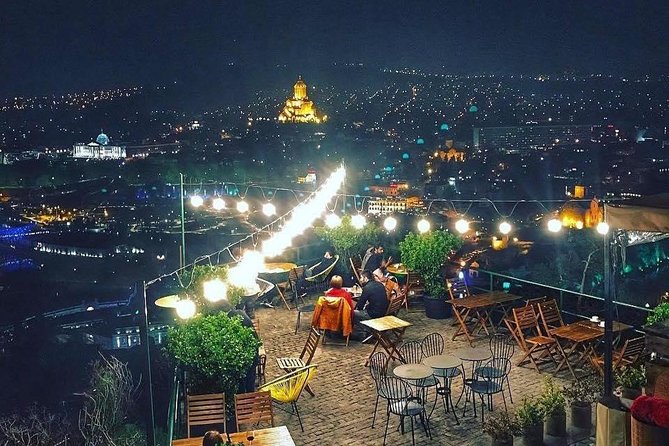
The final destination is Mtatsminda Park and its observation deck. From here, you can look across Tbilisi’s glowing modern and old buildings. This is a strong finish because the earlier stops have taught you what you are seeing. The view is not just a wall of lights. You can pick out the Old Town, the river area, the fortress, and the newer parts of the city.
The tour ends beside the main entrance of the lower funicular station. The funicular round trip is not included, so you should not assume the tour takes you back up or down by funicular. The end point is also practical: your guide can offer final suggestions for meals and further sightseeing.
What the $72.25 price gets you
At $72.25 per person, this is not the cheapest way to take an evening walk through Tbilisi. The value comes from the number of places linked together, the guide’s explanations, and the included one-way cable car.
You are paying for a small-group experience of up to 15 people, an English-speaking guide, all taxes and fees, and the cable car ride. There is no hotel pickup, hotel drop-off, food, or drink. Transportation to and from the attractions is also not separately provided beyond the included cable car.
For a first evening in Tbilisi, I can see the value. You get an organized route through areas that might be harder to connect on your own after dark, plus direct advice about food and the city. One person said the tour was helpful because they did not feel comfortable walking alone at night, even though Tbilisi felt safe to them.
The price makes less sense if you already know the Old Town well or prefer to explore at your own slow pace. You could visit many of these public places without an admission fee. The strongest reason to book is the guide and the efficient route, not paid entry to monuments.
Who will enjoy this evening tour most
I would recommend this tour to a first-time visitor who wants a quick introduction to both old and modern Tbilisi. It is also a good fit if you want company after dark, prefer an English-speaking guide, or want help deciding where to eat after sightseeing.
Photographers should enjoy the route. You get bridge lights, fortress views, balcony houses, the waterfall, the mosque, the sulfur baths, and two elevated viewpoints. The guide may also help with pictures, as one guest praised a guide for taking patient and attractive photos.
The tour is less suitable if you have limited walking ability or want a relaxed meal-focused evening. The route is active, the timing is tight, and some stops are short. Most people can participate, service animals are allowed, and the route is near public transportation, but the supplied details do not specify a fully step-free route.
The tour is often booked about 28 days ahead, so advance planning is sensible if your dates are fixed. Free cancellation is available up to 24 hours before the start time for a full refund. Changes or cancellations inside that window are not accepted for a refund.
Should you book Tbilisi by Night?
Book it if you want a guided first look at Tbilisi after dark, especially if the cable car, viewpoints, and local stories appeal to you. The combination of Berikaoba, the Gabriadze clock tower, the Bridge of Peace, Narikala, Abanotubani, and Mtatsminda gives you a broad sense of the city in one evening.
I would skip it if you want long visits at individual landmarks, a included dinner, or a gentle stroll with plenty of free time. For most first-time visitors, though, the route offers a useful introduction, and a warm guide such as Anya or an engaging guide such as Zora can make the difference between simply seeing Tbilisi and beginning to understand it.
FAQ
How long does the Tbilisi by Night Walking Tour last?
The tour lasts approximately three to three and a half hours.
What time does the tour begin?
The tour starts at 7:00 pm.
Where does the tour begin?
The meeting point is next to the Berikaoba sculpture group at MRW4+HPC, Tbilisi, Georgia.
Where does the tour end?
The tour ends beside the main entrance of the lower station of the Tbilisi Funicular at 22 Daniel Chonqadze Street.
Is the cable car included?
Yes. The one-way Rike-Narikala cable car ride is included.
Is the Tbilisi Funicular included?
No. The funicular round trip is not included in the tour price.
Is food included?
No. Food and drinks are not included, but the guide can recommend places to eat and other things to do in Tbilisi.
Recently added around Tbilisi
- A Gastronomic Private Guided Journey Through Tbilisi★ 5.0 · 8 reviews
- Kakheti Wine Tour for beginners – 3 wineries★ 5.0 · 8 reviews
- Kakheti and Sighnaghi tour with winetasting★ 5.0 · 8 reviews
- Jvari Monastery, Ananuri, Gudauri, Kazbegi Group & Private Tour★ 4.5 · 8 reviews
- Kazbegi & Gudauri group tour from Tbilisi★ 5.0 · 8 reviews
- Tbilisi Lakes and Sightseeing tour★ 5.0 · 8 reviews
- Day Tour to Mtskheta, Gori (Stalin museum) and Uplistsikhe★ 4.5 · 8 reviews
- Group Day Tour of Mtskheta,Jvari,Samtavro★ 4.0 · 8 reviews
Walking Tours, compared.
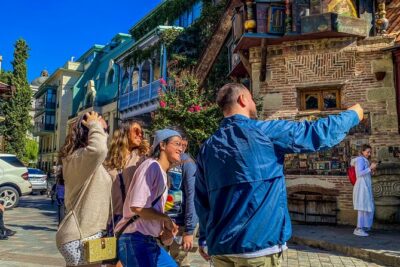
Tbilisi Walking Tour Including Cable Car and Traditional Bakery
Read our review →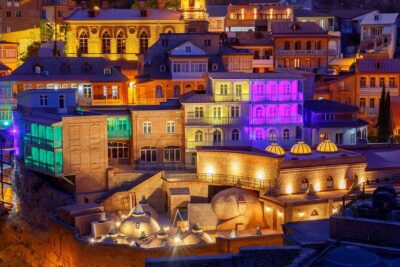
Evening Walking & Talking Tour with Wine & Boat Ride
Read our review →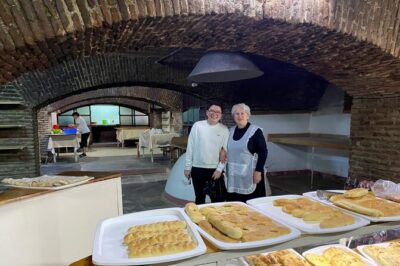
Old Tbilisi Highlights walking tour with wine & 10 tastings
Read our review →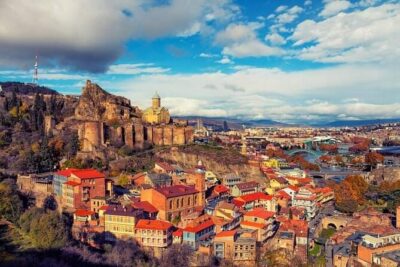
Old Tbilisi Tour: Private Walking Tour With Wine Tasting
Read our review →
Private Tbilisi Food Tour: 9 Tastings Walk in Bohemian District
Read our review →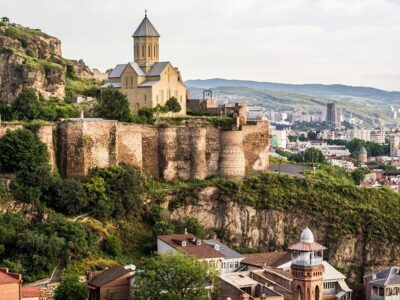
Tbilisi Old Town Walking Tour with a Local Guide
Read our review →
Discover Tbilisi: Hidden Gems and Iconic Sights Walking Tour
Read our review →
Browse the lists this tour appears in