
Reviewed · CITY TOURS
Private Walking Tbilisi City Tour (Day Trip)
Tbilisi rewards curious walkers. This six to seven hour city tour brings together Narikala Fortress, sulfur baths, churches, synagogues, theaters, and modern landmarks, giving you a useful first look at Georgia’s capital. I especially like the multi-faith route, which includes the Jumah Mosque area and Great Synagogue, and the way the tour links old legends to real places. Complimentary bottled water is another small but welcome touch. The main concern is the tour description: it is called private, yet it also describes a shared tour with a possible maximum of 100 people.
The $59 price is fair if you want a guide to connect Tbilisi’s scattered sights and explain the city’s religious and royal past. I also like that the route includes both Old Tbilisi and Rustaveli Avenue, so you see more than the postcard center. Just remember that transportation is not included, and this is a long walking day with many stops.
In This Review
- Five useful things to know before booking
- Why this Tbilisi walking route works
- Narikala Fortress and Tbilisi’s old balconies
- Sulfur baths, Abanotubani, and the city’s origin story
- The Great Synagogue and Tbilisi’s multi-faith past
- Metekhi Cathedral, Rike Park, and the Bridge of Peace
- Kartlis Deda and the city’s symbolic guardian
- Anchiskhati, Sioni, and Tbilisi’s oldest churches
- Rustaveli Avenue and the newer capital
- Leselidze Street and the Marionette Theater
- Leghvtakhevi waterfall, the day’s final surprise
- What $59 buys you
- Who should book this Tbilisi tour?
- Should you book it?
- FAQ
- How long does the Tbilisi city tour last?
- What language is the tour offered in?
- Is transportation included?
- Is bottled water included?
- Is the experience private or shared?
- What sights are included?
- Can most people participate?
- Can I cancel for a full refund?
Five useful things to know before booking
- The route crosses old and modern Tbilisi: You visit Narikala, Abanotubani, Sioni, Rustaveli Avenue, Rike Park, and the Bridge of Peace.
- Faiths share the same city route: The experience includes Georgian Orthodox churches, Catholic and Gregorian churches, the Jumah Mosque area, a former pagan temple site, and the Great Synagogue.
- The advertised format needs checking: The title says private, while the tour details describe a shared experience with up to 100 participants.
- Transportation is not included: You need to reach the starting point in Tbilisi and return there at the end.
- Guiding is the main value: Past feedback gives special praise to guides named Teimuraz and Temo for detailed explanations, patience, and helpful service.
- Weather can affect the day: The tour requires good weather, with a new date or full refund offered if poor conditions force cancellation.
Why this Tbilisi walking route works

Tbilisi is not a city you understand from one grand square. Its character comes from the way Orthodox churches, bathhouses, mosques, synagogues, old balconies, steep hills, modern glass architecture, and narrow lanes sit close together.
This tour gives you that broad picture in one day. You move from the fortress and old city walls to the sulfur baths, then toward Rustaveli Avenue and several major churches. The route also includes Rike Park, the Bridge of Peace, the Mother of Georgia statue, the Marionette Theater, and the waterfall at Leghvtakhevi.
That mix is the strongest part of the experience. You are not seeing only one historic quarter. You are getting an introduction to how Tbilisi grew from a royal and religious center into a modern capital.
The route is also built around stories. The name Tbilisi comes from tbili, meaning warm, a reference to the city’s hot springs. Another tale says King Vakhtang Gorgasali’s falcon fell near the springs, helping lead to the founding of a new capital. These legends give the baths and surrounding streets more meaning than a quick photograph would.
The tour is offered in English, and bottled water is included for each participant. Since the day lasts roughly six to seven hours, that water matters. The schedule includes many short stops, so expect a steady pace rather than a slow, museum-style visit.
More walks:
- Tbilisi Walking Tour Including Cable Car and Traditional Bakery
★ 5.0 · 1,310 reviews - Tbilisi:Evening Walking & Talking Tour with Wine & Boat Ride
★ 5.0 · 572 reviews - Old Tbilisi Highlights walking tour with wine & 10 tastings
★ 5.0 · 276 reviews
Narikala Fortress and Tbilisi’s old balconies
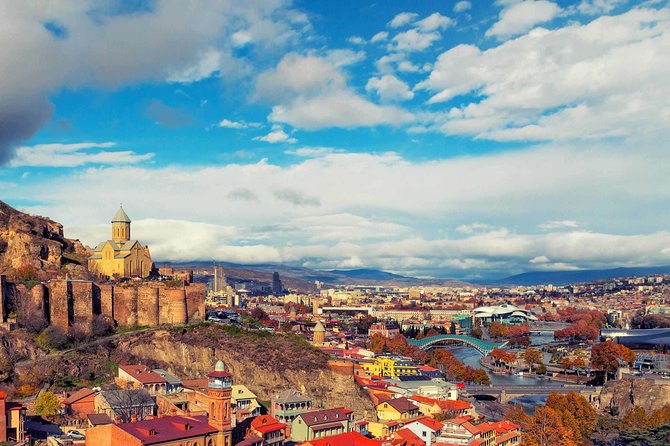
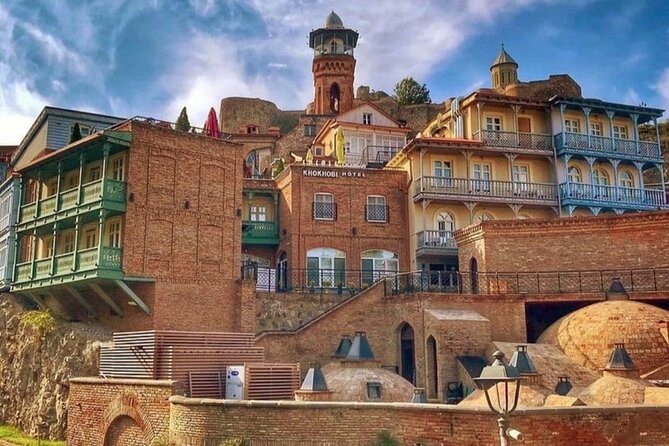
Narikala Fortress is the natural opening point for understanding Tbilisi. From this area, the city’s hills, rooftops, river corridor, and old neighborhoods come together in one view.
The surrounding streets show the typical Tbilisi houses with wooden balconies. These balconies are among the city’s most recognizable details, and they help explain the special look of Old Tbilisi. The tour spends about 50 minutes in this first area, with admission included.
This opening section also introduces the city’s religious variety. Nearby are Catholic and Gregorian churches, the Jumah Mosque, a synagogue, and Ateshga, identified as a temple site connected with pagan worship. That is an impressive amount of cultural ground in a small area.
The main limitation is that the schedule is packed. Fifty minutes is enough for orientation and explanation, but not enough for a long visit inside every religious building or a full exploration of the fortress. Think of this as a guided overview that helps you decide where you may want to return later.
Sulfur baths, Abanotubani, and the city’s origin story
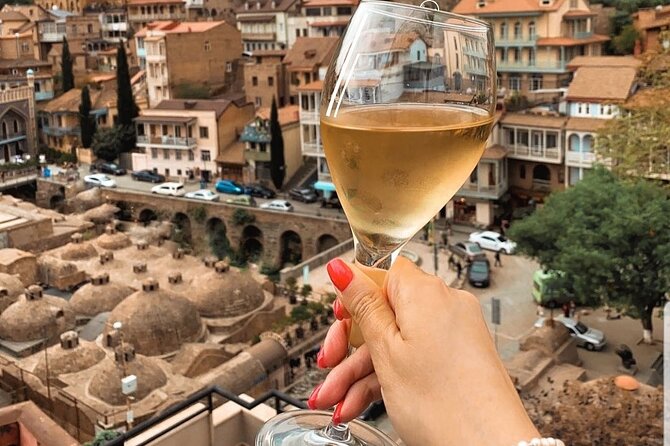
The sulfur bath district, known as Abanotubani, is one of the most atmospheric parts of the route. Its domed bathhouses mark the place where Tbilisi’s hot springs became central to the city’s identity.
The tour allows 30 minutes at the sulfur baths and another 15 minutes specifically in Abanotubani. That gives your guide time to explain both the name Tbilisi and the falcon story connected with King Vakhtang Gorgasali.
You will want to pay attention to the distinction between the bath district and the wider origin story. The first stop focuses on the hot water and the meaning of the city’s name. The Abanotubani stop adds the founding legend and the role of the springs in creating a new capital.
This is one of the places where a guide adds real value. Without context, the bathhouses can look like attractive domes in an old neighborhood. With the story, they become a key to Tbilisi’s beginnings.
The schedule does not include a bath session, and admission to the stops is listed as free. If you want to use a bathhouse, this tour does not promise time or entry for that activity, so treat the stop as sightseeing and explanation.
The Great Synagogue and Tbilisi’s multi-faith past
The Great Synagogue of Tbilisi offers a useful change of focus after the bath district. The building was constructed from 1895 to 1903 in an eclectic style by Georgian Jews from Akhaltsikhe who had moved to Tbilisi in the late 19th century.
It is also known as the Georgian Synagogue and the synagogue of the people of Akhaltsikhe. That detail makes the stop more than an architectural photo opportunity. It points to the movement of communities within Georgia and to Tbilisi’s long role as a meeting place.
The visit is scheduled for about 15 minutes. That is brief, but enough for a guide to explain the building’s background and place it within the wider religious story of Old Tbilisi.
I like this part of the route because it avoids presenting the city as only Georgian Orthodox. The nearby churches, mosque, synagogue, and Ateshga site show a capital shaped by several faiths. For many people, that may be the most valuable theme of the day.
A few more ways to spend a day out of Tbilisi
- Day Trip to Kakheti Wine Region Including 9 Wine Tastings
★ 5.0 · 2,774 reviews - Day Trip to Kazbegi and Gudauri
★ 5.0 · 2,009 reviews - Day Trip to Mtskheta Gori and Uplistsikhe
★ 5.0 · 1,801 reviews - Day Trip to Armenia Including Homemade Lunch
★ 5.0 · 1,162 reviews
Metekhi Cathedral, Rike Park, and the Bridge of Peace
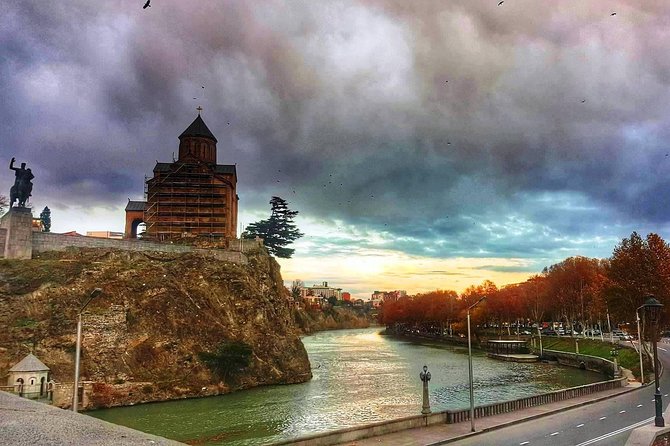
Metekhi Cathedral brings the tour back to royal Georgia. King Vakhtang I Gorgasali is associated with building a church and fort here, along with a royal residence. The name Metekhi dates to the 12th century and means the area around the palace.
The stop lasts about 15 minutes. That is enough to hear the basic story and view the cathedral’s position above the river, but do not expect an extended religious or architectural study.
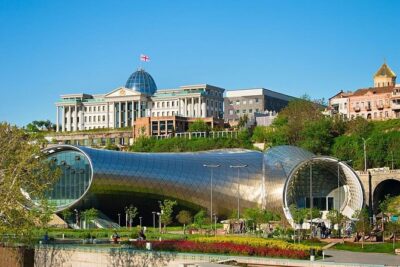
From there, the route includes the Bridge of Peace and Rike Park. The bridge was built in 2009 and 2010, designed by Italian architect Michele De Lucchi, with its lighting system by French designer Philippe Martinaud. Its glass and steel form offers a sharp contrast to the stone churches and old houses.
Rike Park is a modern public space in the Old Town area. It hosts festivals such as Tbilisoba, an important city celebration. Together, the bridge and park show how Tbilisi has added new public architecture without abandoning its historic center.
This contrast is one of the route’s pleasures. You see old religious buildings, royal sites, and bathhouses, then walk through a modern park beside a contemporary bridge. The tour gives you a sense of a city that is still changing.
Kartlis Deda and the city’s symbolic guardian
Kartlis Deda, or the Mother of Georgia, is one of the city’s clearest symbols. The statue carries wine for friends and a sword for enemies, a simple image of Georgian hospitality and defense.
The visit takes about 15 minutes. The statue is important less for a long stop than for what it represents. Your guide can use it to explain a national idea in one memorable picture: welcome is generous, but independence is not negotiable.
Because this area is reached on a walking route through the old city and hill districts, wear shoes that can handle uneven streets and inclines. The tour information does not promise transportation between stops, so you should expect your own legs to do much of the work.
Anchiskhati, Sioni, and Tbilisi’s oldest churches
Anchiskhati Basilica is identified as the oldest surviving church in Georgia and dates to the sixth century. It is a valuable stop for anyone interested in early Georgian Christianity.
The church is also linked with the sculptor Elguja Amashukeli, whose studio was located here. He created Kartlis Deda, tying the old basilica to one of the capital’s most modern symbols.
Sioni Cathedral has an equally layered past. It was built in the sixth and seventh centuries, destroyed by foreign invaders, and rebuilt several times. The current structure is based on a 13th-century version, with later changes from the 17th through 19th centuries.
Sioni served as Georgia’s main Orthodox cathedral and the seat of the Catholicos-Patriarch of All Georgia until the Holy Trinity Cathedral was consecrated. That gives the building national importance, not just local charm.
Each church receives about 15 minutes. You can gather the main facts, see the architecture, and listen to the guide, but the timing is not designed for a long quiet visit. If you want to study frescoes, attend services, or sit inside, you may need to return on your own.
Rustaveli Avenue and the newer capital
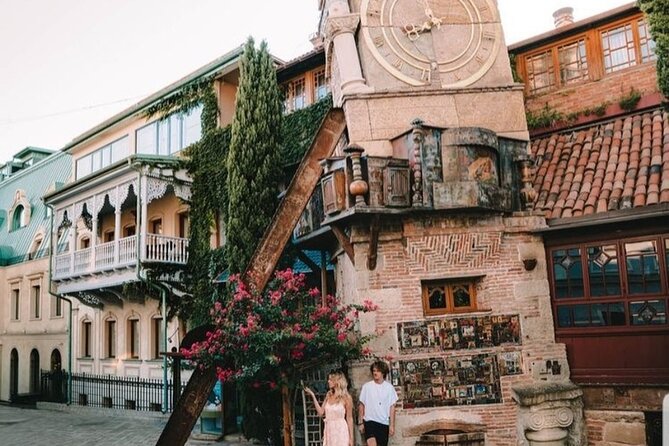
Rustaveli Avenue changes the feel of the day. This is the main public avenue of the newer part of Tbilisi, with important cultural buildings and areas developed after the 20th century.
The route includes the Rustaveli Drama Theater, the State Academic Theater of Opera and Ballet named after Zakaria Paliashvili, the First Gymnasium, and art salons. You spend about an hour here, making it one of the longer portions of the tour.
That hour helps balance the old-city sights. Instead of seeing Tbilisi only as a medieval or early modern place, you get a look at its later cultural life. The theaters and public buildings show the capital as a center for performance, education, and the arts.
This section may also provide a natural pause from the tighter lanes of Old Tbilisi. Still, the experience remains a walking tour, and the full day can feel demanding if you prefer short sightseeing sessions.
Leselidze Street and the Marionette Theater
Leselidze Street links old and new parts of Tbilisi. It is a useful route section because it shows how the city’s historic center functions as a living neighborhood rather than a single preserved monument zone.
The Rezo Gabriadze Marionette Theater receives about 10 minutes. It is one of the city’s best-known sights, and people often wait for its show to begin. The theater is associated with performances described as thoughtful and full of feeling, with an international reputation.
The tour does not include admission to a performance. You see the theater as part of the walking route, which is enough for orientation and a photograph. If the puppet theater interests you, treat this stop as a reminder to make separate plans.
Leghvtakhevi waterfall, the day’s final surprise
The Dzveli Tbilisi sulfur waterfall at Leghvtakhevi is a pleasant final stop because it adds a natural feature to a day otherwise centered on buildings and streets.
The waterfall is 22 meters tall. Its name comes from leghvi, the Georgian word for fig, because many fig trees once grew around the area.
The stop lasts about 20 minutes. That gives you time to see the falls and hear how this tucked-away place fits into the old bath district. It is a good example of Tbilisi’s unusual mix: hot springs, historic lanes, a waterfall, and major religious sites all within the same broad city center.
What $59 buys you
At $59 per person, the price is reasonable if you want a guide for a full day of orientation. Admission is included at Narikala Fortress, and the other listed stops have no admission charge. Bottled water is included, while transportation is not.
The real purchase is not entry tickets. It is the guide’s explanation of why these places matter and how they fit together. Past feedback gives especially warm praise to guides named Teimuraz and Temo. Temo is described as detailed and helpful, while Teimuraz is praised for making the city tour enjoyable. Other comments highlight punctual service, professional staff, patient attention, and strong storytelling.
There is one practical issue to clarify before you pay. The experience is titled private, but the details also call it a shared city tour and allow a maximum of 100 participants. That is a major difference. A private walk should offer a more personal pace, while a large shared group may mean waiting, crowding, or less time for individual questions.
The tour is often booked about 26 days ahead, so planning early may be sensible. Confirmation is provided at booking, and the activity is offered in English.
Who should book this Tbilisi tour?
I would choose this tour if you have one full day in Tbilisi and want a broad introduction without arranging separate visits to each major sight. It suits first-time visitors, history fans, architecture enthusiasts, and anyone curious about Georgia’s Jewish, Muslim, Catholic, Gregorian, and Orthodox heritage.
It also suits you if stories help you remember a city. The founding tale of the sulfur springs, the meaning of Metekhi, the symbolism of Kartlis Deda, and the changing role of Sioni Cathedral give the route a clear narrative.
I would be more cautious if you want a genuinely private experience, a slow pace, or long interior visits. The many 10 to 15 minute stops are useful for seeing a lot, but they leave little room for lingering.
The tour ends back at the meeting point. Since no transportation is included and the route lasts six to seven hours, plan your day around walking and confirm the meeting details before setting out.
Should you book it?
Book this tour if you want one guided day that covers Tbilisi’s fortress, baths, churches, synagogue, theater district, modern bridge, statue, and waterfall. The route is unusually broad, and the multi-faith focus gives you a fuller picture of the capital than a simple Old Town stroll.
Skip it if the private label is essential and the operator cannot confirm that you will have a private guide. At $59, it offers good value for guided context, but its worth depends on group size, walking comfort, and whether you prefer a fast overview or a slow, detailed visit.
FAQ
How long does the Tbilisi city tour last?
The tour lasts approximately six to seven hours.
What language is the tour offered in?
The tour is offered in English.
Is transportation included?
No. Transportation is not included. The activity begins in Tbilisi and ends back at the meeting point.
Is bottled water included?
Yes. Each participant receives complimentary bottled water.
Is the experience private or shared?
The title describes it as private, while the tour details describe it as a shared city tour with a maximum of 100 participants. Confirm the format before booking.
What sights are included?
The route includes Narikala Fortress, the sulfur baths, Rustaveli Avenue, Abanotubani, the Great Synagogue, Metekhi Cathedral, the Bridge of Peace, Rike Park, Kartlis Deda, Anchiskhati Basilica, Sioni Cathedral, Leselidze Street, the Rezo Gabriadze Marionette Theater, and the Leghvtakhevi waterfall.
Can most people participate?
Yes. The activity information says most people can participate.
Can I cancel for a full refund?
Yes, if you cancel at least 24 hours before the experience starts. Cancellations or changes made less than 24 hours before the start time are not refunded or accepted. If poor weather or an insufficient number of participants causes cancellation, you will be offered another date or a full refund.
Recently added around Tbilisi
- Northern Armenia Highlights Tour from Tbilisi★ 5.0 · 3 reviews
- Wild Georgia 4WD PACK Adventure through Kakheti and Kazbegi 2in1★ 5.0 · 3 reviews
- Kakheti wine region – Private Tour★ 5.0 · 3 reviews
- Private Full Day Trip to Kazbegi Mountains★ 5.0 · 3 reviews
- Kakheti With Top Destinations★ 5.0 · 3 reviews
- Jvari monastery & Mtskheta – Half day group tour from Tbilisi★ 5.0 · 3 reviews
- Borjomi – Rabati -Vardzia Private Full Day Tour from Tbilisi★ 5.0 · 3 reviews
- Private Effortless transfer from Tbilisi to Gudauri ski resort★ 5.0 · 3 reviews
City Tours, compared.
City of Love Sighnaghi, Bodbe. KTW. Wine House Group tour
Read our review →
Mtskheta – Jvari. Full City Tour on Hop On Hop Off Bus
Read our review →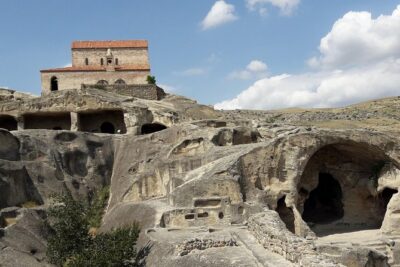
Day tour to Chronicles of Georgia, Gori city, Uplistsikhe cave
Read our review →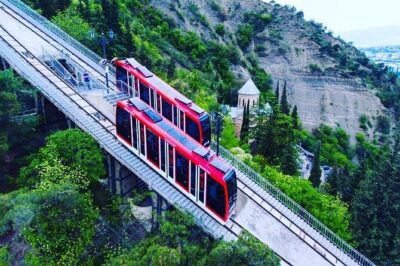
Tbilisi city tour PRIVATE excursion Airport and hotel pickup INCL
Read our review →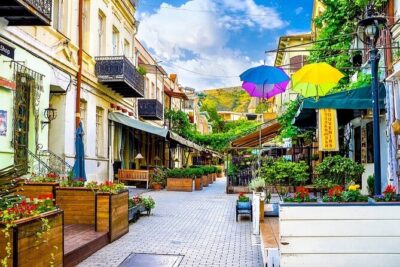
Tbilisi City Tour, Most Popular Tourists Destinations In The Capital Of Georgia
Read our review →
Browse the lists this tour appears in