
Reviewed · MTSKHETA & JVARI TOURS
Tbilisi & Mtskheta city tour
Seven stops connect Georgia’s past and present. This private Tbilisi and Mtskheta tour combines high city views, old neighborhoods, a fortress, a waterfall, and two major Orthodox churches in about five to seven hours. I like the efficient route and the chance to see both the capital and Georgia’s former religious center in one day. I also like that pickup is available from your hotel, Tbilisi International Airport, or an agreed meeting point.
The main consideration is pace. Thirty minutes at several stops is enough for a look and some photographs, but not for a slow museum-style visit. The botanical garden admission is also not included, so check the extra cost before you set off. The tour is private, which gives your own group more control than a large coach trip.
In This Review
- Key points to know before booking
- From Mtatsminda’s cable car to the rooftops of Tbilisi
- The Botanical Garden and Narikala above Old Tbilisi
- Walking through Abanot Ubani to the Bridge of Peace
- Holy Trinity Cathedral and modern Georgian faith
- Jvari Church above the meeting of two rivers
- Svetitskhoveli Cathedral and the older capital at Mtskheta
- What $54 includes in practical terms
- Who will enjoy this route most
- Booking details and cancellation advice
- Should you book the Tbilisi and Mtskheta tour?
- FAQ
- How long does the Tbilisi and Mtskheta tour last?
- Where does the tour start?
- Can I be picked up from my hotel?
- Is airport pickup available?
- Is this a private tour?
- What language is the tour offered in?
- Is the Mtatsminda admission included?
- Is admission to the National Botanical Garden included?
- Are there any free-admission stops?
- Can I cancel for a full refund?
Key points to know before booking
- Mtatsminda begins the day with wide views: The cable-car ride reaches a high point above Tbilisi, with the city opening below you.
- Old Tbilisi comes on foot: Abanot Ubani adds streets, historic landmarks, and a waterfall after the high viewpoints.
- Narikala connects scenery with history: The fourth-century fortress looks over the old city from around 500 meters above sea level.
- Mtskheta adds Georgia’s sacred core: Jvari Church and Svetitskhoveli Cathedral give the second half of the tour a quieter, more historic feel.
- This is a private activity: Only your group participates, and pickup can be arranged from a hotel, airport, or meeting point.
- The price is $54 per person: That can be good value for a full private half-day, especially if transport and guiding are important to you.
From Mtatsminda’s cable car to the rooftops of Tbilisi
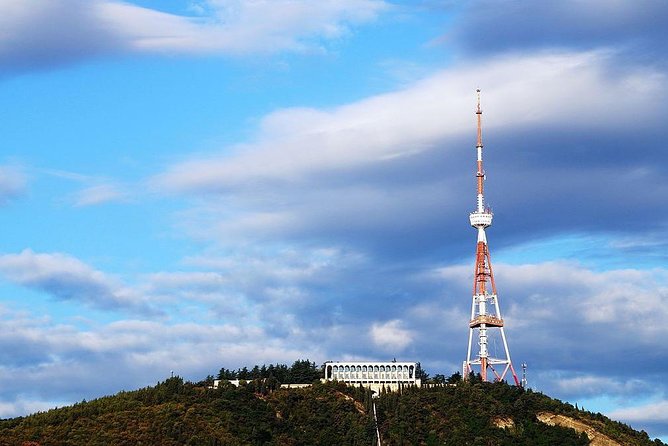
The tour opens with one of the best ways to get your bearings in Tbilisi: rising above it. Tbilisi sits roughly 380 to 600 meters above sea level, and Mtatsminda gives you a clear sense of how the capital spreads across hills and valleys.
The cable-car ride is part of the appeal, not just a way to reach the next stop. As you climb, views begin to open across the city. From Mtatsminda Amusement Park, you can look over Tbilisi from roughly 200 to 300 meters above the city, depending on the viewpoint described by the operator.
You get about 30 minutes here, with admission included. That is enough for photographs and a quick look around, but it is not a long visit to the amusement park itself. The attraction is the view more than the rides.
I would pay close attention during the ascent. The changing angle gives you a useful visual introduction to Tbilisi, a city shaped by hills, the Mtkvari River, and dense older districts. If you are visiting early in your stay, this stop helps you understand the city before you begin walking through it.
The timing also works well. Starting with a viewpoint means the tour begins with a strong visual moment, rather than opening inside a church or museum. The drawback is that the stop may feel brief if you want time for rides, snacks, or a relaxed coffee.
More Mtskheta and Jvari trips:
- Day Trip to Mtskheta Gori and Uplistsikhe
★ 5.0 · 1,801 reviews - Tbilisi:Mtskheta,Jvari,Bazaar,wine tasting,Chronicles of Georgia
★ 5.0 · 730 reviews - Mtskheta-Gori-Uplistsikhe
★ 5.0 · 112 reviews
The Botanical Garden and Narikala above Old Tbilisi
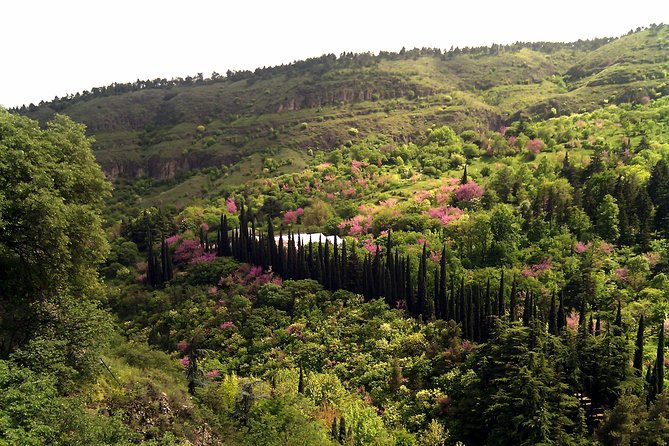
The next stop is the National Botanical Garden of Georgia, located around 500 meters above sea level and overlooking the city. It contains plants and flowers from many parts of the world, offering a change of pace from the stone buildings and traffic of central Tbilisi.
You have about 30 minutes here. Admission is not included, so this is one detail to clarify before departure. The tour description gives no separate admission price, and the visit may be more appealing to you if gardens are a priority rather than a quick side stop.
The garden matters because it shows a softer side of Tbilisi. You are not only looking at churches and fortifications. You are also seeing how the city’s hills support planted spaces and walking routes.
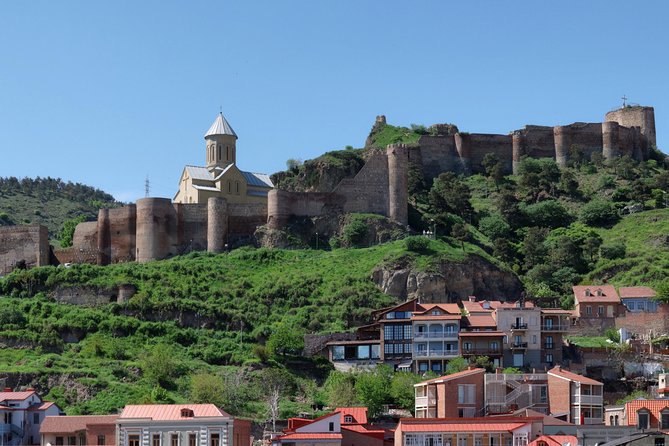
Narikala Fortress follows with another 30-minute stop. The fortress was established in the fourth century and expanded in the eleventh century during the reign of King Davit Agmashenebeli. Its position around 500 meters above sea level gives it a commanding view over Old Tbilisi.
Narikala is not presented as a long archaeological visit. Think of it as a compact historical stop with a strong outlook. You can connect the fortress to the city below, including the old neighborhoods that grew around the river and sulfur-bath district.
The combination of garden and fortress is one of the day’s better pairings. One gives you plants and open space. The other gives you stone walls, elevation, and a sense of Tbilisi’s defensive past.
The 30-minute limit requires sensible expectations. You will have time to see the main area and take photographs, but you may not have the freedom to wander every path or inspect every part of the fortress. Comfortable shoes are a practical choice because the day includes walking through old districts and visiting hilltop sites.
Walking through Abanot Ubani to the Bridge of Peace
After the high points, the route comes down toward central Tbilisi by cable car and reaches European Square. From there, you walk through Abanot Ubani, one of the oldest parts of the city.
This section gives the tour its most street-level character. Abanot Ubani is tied to the early development of Tbilisi, and the route includes old landmarks, a waterfall, and the feeling of an older city district. The descriptions point to streets that evoke seventeenth and eighteenth-century Tbilisi, giving you a better connection to the city than a series of distant viewpoints would.
The Bridge of Peace is listed as the stop, but the surrounding walk is just as important. The bridge itself is a modern feature, while Abanot Ubani brings older buildings and local texture. That contrast helps explain Tbilisi as it is now: a capital where newer architecture sits close to centuries-old lanes and religious sites.
You get about 30 minutes here. That makes this more of a guided introduction than a full neighborhood walk. If you want time for the waterfall, photographs, and a careful look at the streets, you may need to keep moving.
This is also the part of the tour where the guide can add the most value. A good guide can explain what you are looking at while keeping the walk moving. Nina is praised in the provider’s trip feedback for being patient, polite, obliging, and able to communicate well in English. Those qualities matter in a compact walking stop, where clear explanations can prevent the experience from becoming a rushed photo break.
Holy Trinity Cathedral and modern Georgian faith
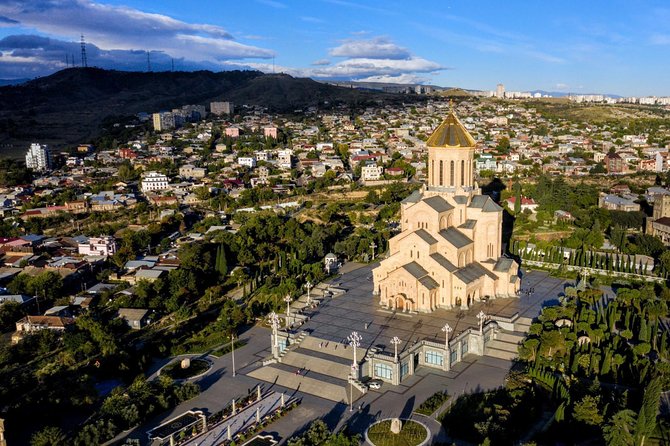
The tour finishes its Tbilisi portion at the Holy Trinity Cathedral, also called Sameba. Construction began in 1995 and ended in 2003. It was built in connection with Georgia’s long Orthodox and Christian traditions, including 1,500 years of autocephaly and 2,000 years of Christianity.
The cathedral is described as the third-largest Orthodox cathedral in the world. You have about 30 minutes, and admission is free. The visit gives you a chance to see a major modern religious building before the tour leaves the capital for Mtskheta.
The cathedral is useful in the overall sequence because it brings the story into the present. Mtatsminda and Narikala reach back toward the city’s older foundations. Sameba shows how Georgia’s religious identity continues in a large, recent building.
Allow time for a respectful visit. This is an active Orthodox place of worship, not simply a sightseeing stop. Modest clothing and quiet behavior are sensible, even though the tour information does not specify a dress code.
The cathedral visit is also a reminder that Tbilisi cannot be reduced to old walls and picturesque lanes. The capital has a modern civic scale, major religious buildings, and a strong connection to Georgian Orthodox life.
A few more ways to spend a day out of Tbilisi
- Day Trip to Kakheti Wine Region Including 9 Wine Tastings
★ 5.0 · 2,774 reviews - Highlights of Caucasus Mountains-Jinvali,Ananuri,Gudauri,Kazbegi(Group tour)
★ 5.0 · 2,682 reviews - Day Trip to Kazbegi and Gudauri
★ 5.0 · 2,009 reviews - Tbilisi Walking Tour Including Cable Car and Traditional Bakery
★ 5.0 · 1,310 reviews
Jvari Church above the meeting of two rivers
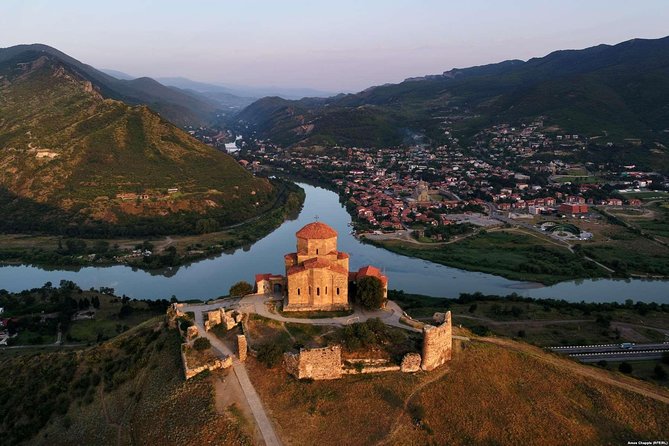
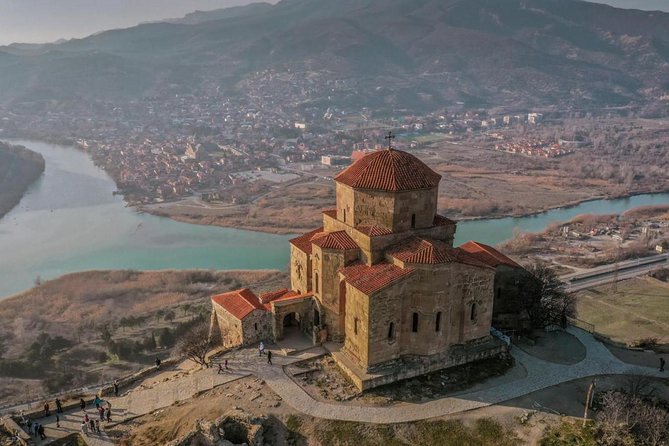
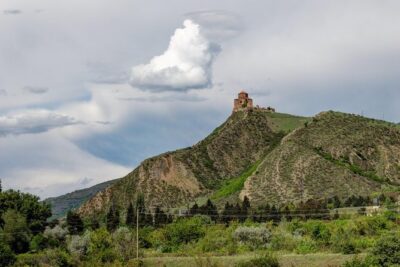
The second half of the tour takes you toward Mtskheta, but first stops at Jvari Church. The monastery sits on a mountain overlooking the old city and the point where the Aragvi and Kura, also called the Mtkvari, rivers meet.
This is one of the day’s strongest viewpoints. From Jvari, you can see Mtskheta below, the two rivers joining, and wave-like mountain forms beyond. The panorama gives physical meaning to the location of Mtskheta. You are not simply visiting an old town. You are seeing why this place held such importance in Georgia.
The monastery’s origins reach back to the fourth century, soon after Georgia accepted Christianity. The larger church was built in the eleventh century. That gives the site a long religious timeline, but the visit itself remains easy to understand: a hilltop church, a wide view, and a direct link to Georgia’s conversion to Christianity.
Admission is free, and the planned stop lasts 30 minutes. I would treat this as a viewpoint and a brief church visit rather than a long monastic exploration. Weather and visibility will affect how much you get from the panorama.
Jvari is particularly valuable for visitors who enjoy seeing history in its setting. The church, city, rivers, and hills form one picture. You do not need a long lecture to understand the importance of the site once you are looking down over Mtskheta.
Svetitskhoveli Cathedral and the older capital at Mtskheta
Mtskheta is the final major stop. Historical records refer to the city as far back as 2,000 to 3,000 years ago, while dense settlement is placed around the third or fourth century BC. It served as an important early center before Tbilisi became the capital.
Svetitskhoveli Cathedral receives about an hour, the longest stop of the day. Construction began in 1010 and ended in 1029. The cathedral is free to enter and is presented as a place holding four major Orthodox relics:
- The mantle of the prophet Isaiah
- The robe of Jesus Christ
- A particle of the Apostle Andrew
- Small particles of the cross associated with the crucifixion of Jesus
These claims are part of the cathedral’s religious tradition, and the site carries great importance for Georgian Orthodox Christianity. You should approach the visit as a sacred place first and a historic monument second.
The one-hour allowance is a welcome change after several half-hour stops. It gives you more time to take in the cathedral, hear the guide’s explanation, and experience Mtskheta without feeling quite as hurried.
Mtskheta also changes the mood of the tour. Tbilisi is the capital, with viewpoints, bridges, cable cars, and a mixture of old and new. Mtskheta feels more focused on Georgia’s religious and early political past. Pairing the two cities makes the tour much more useful than a Tbilisi-only sightseeing loop.
What $54 includes in practical terms
The listed price is $54 per person. Value depends on the size of your private group, but the offering includes a five to seven-hour route covering seven stops, transport between Tbilisi and Mtskheta, a guide, and pickup arrangements.
The tour is private, so only your group participates. That is important. You are not being placed with an unknown coach group, and the pace can be easier to manage within the limits of the schedule. Pickup can be arranged from your hotel, Tbilisi International Airport, or a meeting point agreed the day before.
Mtatsminda admission is included, while the National Botanical Garden admission is not. The other listed stops have free admission. You should ask exactly how the cable-car rides and any other transport costs are handled when booking, since the description refers to cable-car travel but does not break out every transport charge.
At five to seven hours, this is a substantial half-day outing. The lower end of the timing may feel tight if traffic, walking, or time at the churches slows the route. The longer end gives you a more relaxed day. The price is strongest for people who value door-to-door convenience, a private vehicle, and an English-speaking guide rather than trying to connect the same places alone.
The provider’s wider trip feedback repeatedly praises friendly and accommodating staff. Names attached to those comments include Mamuka, Beso, George, and Nina. George is described as patient, thoughtful, punctual, and responsive, while Beso is associated with city and nature outings. Those comments suggest that guide quality is a major part of the experience, though the exact guide for this booking is not guaranteed.
Who will enjoy this route most
I would recommend this tour to a first-time visitor who wants a clear introduction to Tbilisi and Mtskheta without arranging several separate excursions. It suits you if you want major views, key churches, Old Tbilisi, and a short taste of Georgian religious history in one organized day.
It is also a good match for families or private groups who prefer pickup and a known group size. The tour information says most people can participate, service animals are allowed, and the route is near public transportation. Still, the hilltop sites, cable cars, and walking sections may be tiring for anyone who has difficulty walking or managing uneven ground.
You will probably like it less if you prefer long, unhurried visits. Four stops are scheduled for about 30 minutes, and the route covers a lot of ground. It is designed to show you the main places, not to give you half a day in one church or neighborhood.
Food is not listed as part of this activity. Georgia’s cuisine is one of the pleasures of a visit, with dishes such as khinkali, mtsvadi, and khachapuri praised in the provider’s broader trip feedback, along with Georgian wine. You should plan any meal separately rather than assuming one is included.
Booking details and cancellation advice
Confirmation is provided at the time of booking. The experience is offered in English, includes mobile ticketing, and may provide group discounts.
Free cancellation is available if you cancel at least 24 hours before the local start time. A cancellation within 24 hours is not refundable, and changes inside that window are not accepted. The activity also requires a minimum number of participants. If that minimum is not reached and the provider cancels, you are offered another date or experience, or a full refund.
Because pickup arrangements may be discussed the day before, give the provider your hotel or airport details clearly. If you are arriving at Tbilisi International Airport and want to begin immediately, confirm the timing before assuming the full sightseeing route can start on arrival day.
Should you book the Tbilisi and Mtskheta tour?
Book it if you want broad coverage in one private outing. The route links Tbilisi’s best viewpoints and old streets with Mtskheta’s two major religious sites, and the $54 price can be fair for the time, transport, pickup, and personal guide.
Skip it if you want a slow botanical garden visit, extended fortress exploration, or a full day focused on one neighborhood. The schedule is brisk, and the garden entrance is extra.
For a first visit, I like the balance: modern Tbilisi, Old Tbilisi, hilltop history, and Mtskheta’s sacred center. Just confirm the guide, transport costs, garden admission, pickup time, and expected duration before paying.
FAQ
How long does the Tbilisi and Mtskheta tour last?
The tour lasts approximately five to seven hours.
Where does the tour start?
The listed starting point is Old Tbilisi, Tbilisi, Georgia.
Can I be picked up from my hotel?
Yes. Pickup can be arranged from the hotel where you are staying in Tbilisi.
Is airport pickup available?
Yes. Pickup is offered from Tbilisi International Airport.
Is this a private tour?
Yes. Only your group participates in the activity.
What language is the tour offered in?
The tour is offered in English.
Is the Mtatsminda admission included?
Yes. Admission for the Mtatsminda Amusement Park stop is included.
Is admission to the National Botanical Garden included?
No. Admission to the National Botanical Garden is not included.
Are there any free-admission stops?
Yes. Narikala Fortress, the Bridge of Peace area, Holy Trinity Cathedral, Jvari Church, and Svetitskhoveli Cathedral are listed with free admission.
Can I cancel for a full refund?
Yes, if you cancel at least 24 hours before the experience start time. Cancellations made less than 24 hours before the start are not refunded.
Recently added around Tbilisi
- Northern Armenia Highlights Tour from Tbilisi★ 5.0 · 3 reviews
- Wild Georgia 4WD PACK Adventure through Kakheti and Kazbegi 2in1★ 5.0 · 3 reviews
- Kakheti wine region – Private Tour★ 5.0 · 3 reviews
- Private Full Day Trip to Kazbegi Mountains★ 5.0 · 3 reviews
- Kakheti With Top Destinations★ 5.0 · 3 reviews
- Jvari monastery & Mtskheta – Half day group tour from Tbilisi★ 5.0 · 3 reviews
- Private Effortless transfer from Tbilisi to Gudauri ski resort★ 5.0 · 3 reviews
- Borjomi – Rabati -Vardzia Private Full Day Tour from Tbilisi★ 5.0 · 3 reviews
Mtskheta & Jvari Tours, compared.
Mtskheta,Jvari,Bazaar,wine tasting,Chronicles of Georgia
Read our review →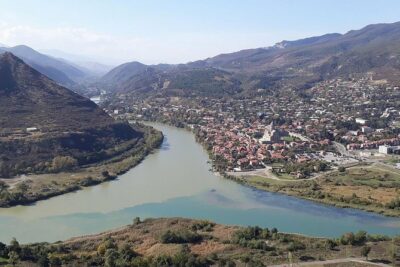
Mtskheta, Jvari, gori, uflistsikhe, history and panorama (group tours)
Read our review →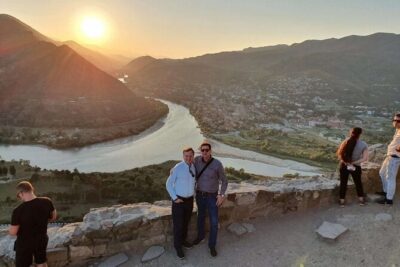
Jvari-Uplistsike-Chronicle of Georgia, PRIVATE Trip
Read our review →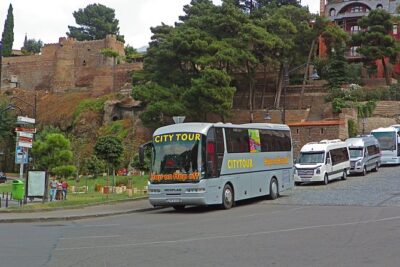
Mtskheta – Jvari. Full City Tour on Hop On Hop Off Bus
Read our review →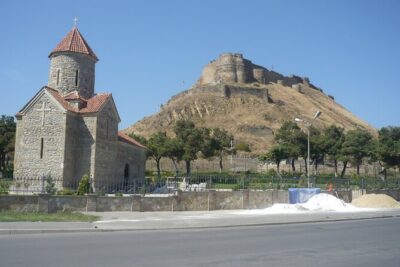
Ancient Georgia Group Tour: Mtskheta,Jvari, Gori, Uplistsikhe
Read our review →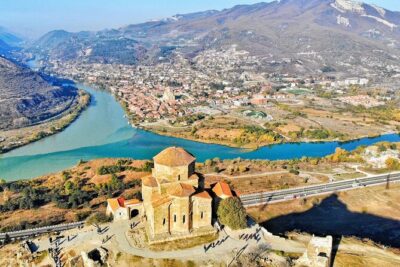
Ancient Mtskheta and Chronicle of Georgia half day tour
Read our review →Browse the lists this tour appears in