
Reviewed · MTSKHETA & JVARI TOURS
Mtskheta Tour with All UNESCO Sites & Ancient Ruins
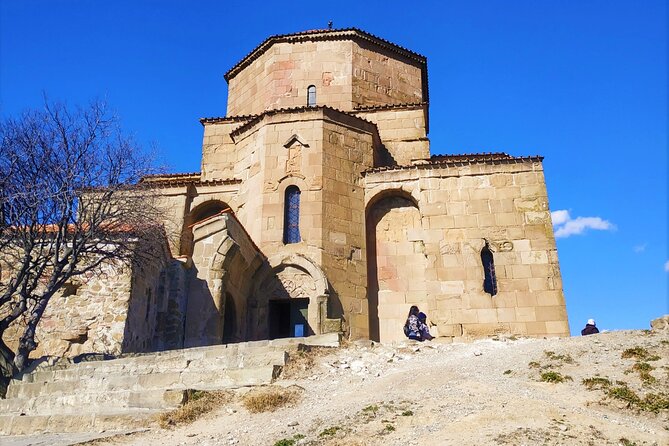
Ancient Georgia comes alive around Mtskheta. This nine-hour private excursion from Tbilisi combines Jvari Church, Svetitskhoveli Cathedral, Samtavro Church, and Shio-Mgvime Monastery in one well-planned day. You get hotel pickup, a private air-conditioned vehicle, and an English-speaking guide, which makes the trip simple from the start.
I especially like the private format, since your group can set its own pace instead of following a large crowd. I also like the mix of grand churches and quieter monastic ruins, from the hilltop view at Jvari to the cave-linked setting of Shio-Mgvime. The main drawback is the length: nine hours, walking over uneven ground and stairs, can feel tiring, especially in warm weather.
The guide named in the feedback is Giorgi, praised for clear storytelling and for allowing time at each site. That balance matters here. Mtskheta is not just a checklist of old buildings. It is a living religious center, so good explanations help you understand what you are seeing without rushing through it.
In This Review
- Key things to know before booking
- Why Mtskheta deserves a full day from Tbilisi
- Jvari Church and the first great view
- Svetitskhoveli Cathedral in the old capital
- Samtavro Church and the story of Saint Nino
- Shio-Mgvime Monastery and its cave tradition
- What the private format adds
- Lunch, walking, and what to wear
- Who will enjoy this tour most
- Booking, cancellation, and weather
- Should you book this Mtskheta tour?
- FAQ
- How long does the Mtskheta tour last?
- What time does the tour begin?
- Is hotel pickup available?
- Is this a private tour?
- Which sites are included?
- Is lunch included?
- Is the tour offered in English?
- What should women wear inside the churches?
- Can I cancel for a full refund?
Key things to know before booking
- Jvari gives you the day’s big view: The sixth-century monastery sits on Jvari Mount, about 656 meters above sea level, overlooking the area around Mtskheta.
- Four major religious sites fit into one private day: You visit Jvari, Svetitskhoveli, Samtavro, and Shio-Mgvime without arranging separate transport.
- Svetitskhoveli is the emotional center: The cathedral is linked to the claimed burial place of Christ’s mantle and served as a burial church for Georgian kings.
- The route mixes famous and quieter places: Jvari and Svetitskhoveli are essential sights, while Shio-Mgvime offers a more secluded monastic setting.
- Dress rules are part of the experience: Women need headscarves and dresses, while men cannot wear short trousers inside Georgian Orthodox churches.
- The price buys privacy and convenience: At $127.50 per person, the value is strongest for couples, families, or small groups that want private transport and guiding.
Why Mtskheta deserves a full day from Tbilisi
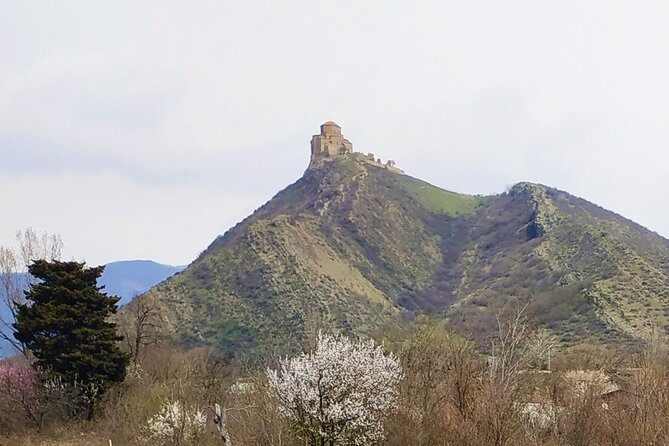
Mtskheta was an ancient capital of Georgia and remains one of the country’s most important Orthodox centers. Its churches are not isolated museum pieces. They are places of worship, pilgrimage, burial, and national memory.
That gives this excursion more weight than a simple drive to a nearby town. You see the location where early Georgian Christianity took shape, then trace its development through several buildings from the sixth to the eleventh centuries.
The tour begins at 9:00 a.m. and lasts about nine hours. That is enough time for the four principal stops, a walk through Mtskheta’s old town, and a meal stop if you choose the lunch option. You should expect a full day rather than a quick half-day outing.
The private vehicle is useful because the sites are spread across different settings. Jvari is high above Mtskheta, Svetitskhoveli and Samtavro are in town, and Shio-Mgvime lies in a separate monastic setting. Air conditioning will also be welcome during Georgia’s hotter months.
More Mtskheta and Jvari trips:
- Day Trip to Mtskheta Gori and Uplistsikhe
★ 5.0 · 1,801 reviews - Tbilisi:Mtskheta,Jvari,Bazaar,wine tasting,Chronicles of Georgia
★ 5.0 · 730 reviews - Mtskheta-Gori-Uplistsikhe
★ 5.0 · 112 reviews
Jvari Church and the first great view
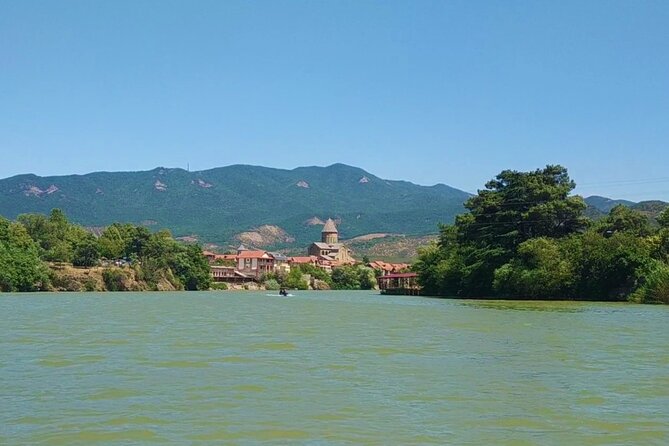
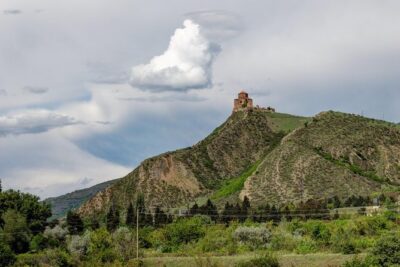
Your first stop is Jvari Church, a sixth-century Georgian Orthodox monastery on Jvari Mount. The drive up gives you a broad view of Mtskheta and the surrounding area, including the water visible from the mountain. This is the moment when the geography of the day begins to make sense.
Jvari is important for more than its age. It survived with its basic form almost unchanged and helped establish the Jvari type of church architecture, a design later used in Georgia and Armenia. Its compact shape, central dome, and position above the town show how Georgian builders connected sacred buildings with their surroundings.
You have about 30 minutes here, with no admission charge. That is enough for a focused visit and photographs, but not for a long architectural study. The mountain location can also mean wind, sun, or uneven walking, so bring a layer and wear shoes with a firm sole.
I would pay close attention to the guide at this stop. Without context, Jvari can seem like a small stone church with a great view. With an explanation of its age, design, and role in Georgian Christianity, it becomes one of the clearest introductions to the country’s early medieval architecture.
Svetitskhoveli Cathedral in the old capital
The visit to Svetitskhoveli Cathedral lasts about an hour. Located in the historic center of Mtskheta, it is the largest and most elaborate church on this route.
The present cross-in-square cathedral was completed between 1010 and 1029 by the medieval architect Arsukisdze. The site itself reaches back to the early fourth century, when Christianity was taking root in Georgia. The exterior stone decoration, especially the arches and carved details, offers a strong example of eleventh-century Georgian design.
Svetitskhoveli is also one of the most sacred places in the country. Georgian Orthodox tradition identifies it as the burial place of Christ’s mantle, and Georgian kings were buried here across the centuries. That tradition is central to the cathedral’s importance, even though it is a matter of religious belief rather than a fact that can be independently verified.
Inside, you may notice that the building carries signs of a difficult past. Some valuable frescoes were whitewashed during the period of Russian Imperial rule, and not all were recovered. That loss is worth remembering as you admire the surviving paintings and stonework.
The cathedral remains an active place of worship. Dress modestly, lower your voice, and be ready for religious activity rather than treating the building as a silent monument. The one-hour visit gives you time to look closely, listen to the guide, and walk around the old town nearby.
Samtavro Church and the story of Saint Nino
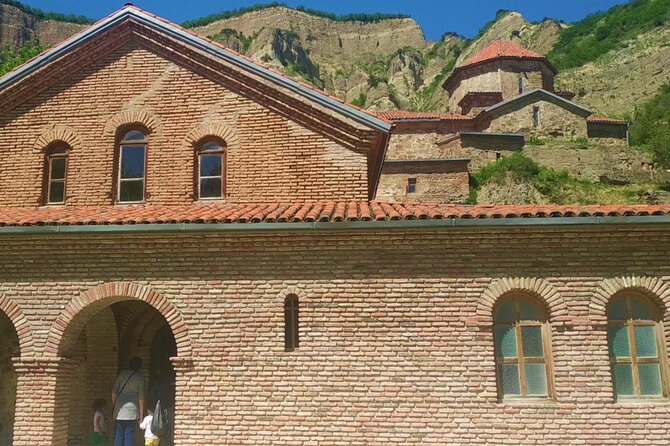
Samtavro Monastery is a shorter, 30-minute stop, but it adds an important chapter to the day. The site was founded in the fourth century by King Mirian III, and a small church was built here by Saint Nino.
The main church dates stylistically to the first half of the eleventh century. It was probably built or rebuilt soon after Svetitskhoveli under King George I and Catholicos-Patriarch Melchizedek I. The complex combines the Transfiguration Church with the Nunnery of St. Nino.
This is a useful place to compare buildings. Jvari shows an early, compact church form. Svetitskhoveli presents a powerful cathedral built for a royal and national center. Samtavro brings the story back to a monastery with links to Saint Nino and the beginnings of Georgian Christianity.
Thirty minutes is a sensible amount of time, though you may wish it were longer if you enjoy religious art or want to sit quietly. The private format helps here because you are not forced to move on at the exact moment a large group does.
A few more ways to spend a day out of Tbilisi
- Day Trip to Kakheti Wine Region Including 9 Wine Tastings
★ 5.0 · 2,774 reviews - Highlights of Caucasus Mountains-Jinvali,Ananuri,Gudauri,Kazbegi(Group tour)
★ 5.0 · 2,682 reviews - Day Trip to Kazbegi and Gudauri
★ 5.0 · 2,009 reviews - Tbilisi Walking Tour Including Cable Car and Traditional Bakery
★ 5.0 · 1,310 reviews
Shio-Mgvime Monastery and its cave tradition
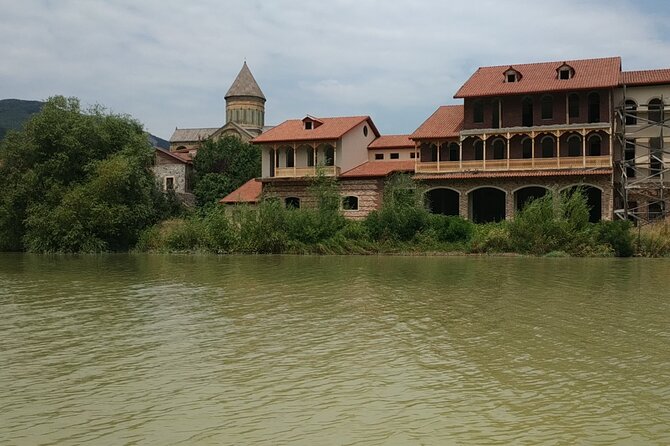
Shio-Mgvime is the most different stop on the route. The monastery was founded in the sixth century by Saint Shio, one of the Thirteen Assyrian Fathers who came to Georgia as Christian missionaries.
The earliest building is the Church of St. John the Baptist, a cruciform structure dating from the 560s to the 580s. Its design is plain and restrained, with an octagonal dome and a conical roof. The church once housed a stone iconostasis, which is now in the Art Museum of Georgia.
Saint Shio spent his last years as a hermit in a deep cave, and that detail gives the monastery a more austere character than the grand cathedral in Mtskheta. The complex changed in the eleventh and eighteenth centuries, but its original architectural character remains.
You have about an hour here. That allows time to take in the setting, hear the story of Saint Shio, and look carefully at the early church. The terrain is part of the visit. You will walk over various surfaces and may encounter stairs, so comfortable shoes are not optional advice.
Shio-Mgvime also provides a welcome change of pace. After the formal scale of Svetitskhoveli and the panoramic position of Jvari, the monastery feels quieter and more personal. If you enjoy early religious sites with a strong connection to individual figures, this may be your favorite stop.
What the private format adds
A private tour is not automatically better than a group tour, but this route gives it a real advantage. The four sites have different atmospheres, and you may want more time at one church and less at another. Your guide can explain the details that interest you instead of delivering a fixed speech to a busload of people.
The feedback about Giorgi is particularly encouraging. He is described as a storyteller who explains the monuments clearly and gives people time to absorb the setting. Another account praises the lack of rushing, which is valuable at places of worship where a few quiet minutes can matter as much as a list of dates.
Pickup is offered, so you do not need to find your way to a distant meeting point. After pickup, the private air-conditioned vehicle keeps the day comfortable and makes it easier to carry water, extra clothing, or purchases from Mtskheta.
The tradeoff is cost. At $127.50 per person, this is not the cheapest way to see Mtskheta. The value improves as your group grows, since the price includes private transport and a dedicated guide rather than only a seat on shared transport. For a couple or small family, the comfort and flexible pace may justify the premium.
Lunch, walking, and what to wear
Lunch depends on the option you book. A tour with lunch includes a meal, while the budget option does not. Even on the budget version, the day includes a stop at a restaurant for lunch, so you should plan for time to eat but confirm what is included in your selected package.
Tell the operator about dietary restrictions if you choose the lunch option. This is a small step, but it prevents confusion during a long day away from Tbilisi.
Walking is not extreme in the sense of a mountain hike, but the old town and monasteries involve varied terrain and stairs. Jvari’s hilltop position and Shio-Mgvime’s monastic setting make supportive shoes essential. Sandals with a poor grip could make the day less pleasant.
Church clothing rules are strict enough to plan around. Women need a headscarf and a dress in Georgian Orthodox churches. Men cannot wear short trousers. Scarves and dresses may be available near some entrances, but I would not rely on that. Bringing suitable clothing is easier and more respectful.
Who will enjoy this tour most
I would recommend this excursion to anyone staying in Tbilisi who wants the main Mtskheta religious sites explained in one day. It suits first-time visitors especially well, since the guide can connect the buildings, saints, rulers, and architectural changes into one clear story.
It is also a good choice for families or small groups. Private pickup removes transport stress, and the air-conditioned vehicle gives you a comfortable base between stops. The ability to ask questions directly can make the visit more engaging for children and adults with different interests.
History and architecture fans will appreciate the range of dates. You move from early fourth-century Christian foundations to sixth-century monasteries and eleventh-century cathedrals. People mainly seeking shopping or an easy café day may find the schedule too focused on churches and ruins, though Mtskheta also has places to buy gifts during free moments.
The tour is less suitable if you dislike religious sites, stairs, or long days. The churches are active Orthodox spaces, not simply attractions. You need to accept modest clothing, quiet behavior, and a fair amount of walking.
Booking, cancellation, and weather
Confirmation is provided at booking, and the tour is offered in English. Group discounts are available, and the activity is private, meaning only your own group participates.
Free cancellation applies if you cancel at least 24 hours before the 9:00 a.m. start time. Canceling later or making changes within that 24-hour period does not qualify for a refund. The experience also requires good weather. If poor weather causes cancellation, you are offered another date or a full refund.
Those rules are worth noting because Jvari depends on its hilltop setting and views. A gray or rainy day does not erase the churches’ importance, but it can reduce the pleasure of the first stop and make the walking less comfortable.
Should you book this Mtskheta tour?
Book it if you want all four major sites, private transport, and a guide who gives the places enough time to make sense. The strongest parts are the view from Jvari, the sacred importance of Svetitskhoveli, and the contrast between the grand cathedral and the quieter Shio-Mgvime Monastery.
At $127.50 per person, the tour makes the most sense for a small group that values convenience and personal attention. If you are traveling alone on a tight budget, a shared excursion may cost less. But if you want a calm, well-supported day from Tbilisi, this private route offers a strong introduction to Georgia’s early Christian capital.
FAQ
How long does the Mtskheta tour last?
The experience lasts approximately nine hours.
What time does the tour begin?
The tour starts at 9:00 a.m.
Is hotel pickup available?
Yes, pickup is offered.
Is this a private tour?
Yes. Only your own group participates in the activity.
Which sites are included?
The route includes Jvari Church, Svetitskhoveli Cathedral, Samtavro Church, and Shio-Mgvime Monastery.
Is lunch included?
Lunch depends on the option you book. The budget option does not include lunch, but it includes a stop at a restaurant. A lunch option is also available.
Is the tour offered in English?
Yes, the tour is offered in English.
What should women wear inside the churches?
Women need to wear headscarves and dresses in Georgian Orthodox churches. Scarves and dresses may be available near some church entrances.
Can I cancel for a full refund?
Yes, if you cancel at least 24 hours before the experience begins. Cancellations made less than 24 hours before the start time are not refunded.
Recently added around Tbilisi
- Northern Armenia Highlights Tour from Tbilisi★ 5.0 · 3 reviews
- Wild Georgia 4WD PACK Adventure through Kakheti and Kazbegi 2in1★ 5.0 · 3 reviews
- Kakheti wine region – Private Tour★ 5.0 · 3 reviews
- Jvari monastery & Mtskheta – Half day group tour from Tbilisi★ 5.0 · 3 reviews
- Private Full Day Trip to Kazbegi Mountains★ 5.0 · 3 reviews
- Kakheti With Top Destinations★ 5.0 · 3 reviews
- Private Effortless transfer from Tbilisi to Gudauri ski resort★ 5.0 · 3 reviews
- Borjomi – Rabati -Vardzia Private Full Day Tour from Tbilisi★ 5.0 · 3 reviews
Mtskheta & Jvari Tours, compared.
Mtskheta,Jvari,Bazaar,wine tasting,Chronicles of Georgia
Read our review →
Mtskheta, Jvari, gori, uflistsikhe, history and panorama (group tours)
Read our review →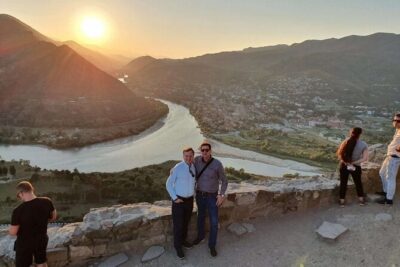
Jvari-Uplistsike-Chronicle of Georgia, PRIVATE Trip
Read our review →
Mtskheta – Jvari. Full City Tour on Hop On Hop Off Bus
Read our review →
Ancient Georgia Group Tour: Mtskheta,Jvari, Gori, Uplistsikhe
Read our review →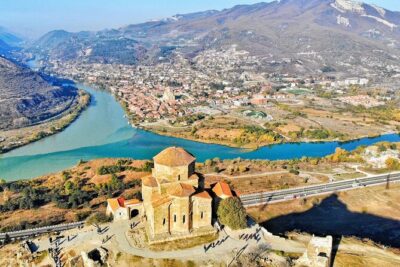
Ancient Mtskheta and Chronicle of Georgia half day tour
Read our review →Browse the lists this tour appears in