
Reviewed · FOOD & DRINK
Tbilisi Food Tour in a Local Family
Georgia puts its welcome on the dinner table. This three-hour Tbilisi food tour combines a hands-on cooking class with a meal inside a local family home. I like the generous menu, which includes khinkali, khachapuri, eggplant with walnuts, salad, mchadi, and Sulguni cheese. I also like that homemade wine and chacha are part of the experience, not an extra charge. The main thing to consider is the late 6 p.m. start and the fact that you must arrange your own transport after the meal.
The evening begins at Traveler’s Meeting Point, then moves by arranged transport to a family home at 45 Gigo Zaziashvili Street. Guides such as Beka, Buta, Helen, Toko, and Tornike have helped make this experience warm and social. The cooking is the star, but the meal can be very filling, and the tour may feel long if you want only a quick tasting.
In This Review
- Key points to know before booking
- Why Georgian food makes a good Tbilisi evening
- Starting at Traveler’s Meeting Point
- The ride to a family kitchen
- Making six Georgian dishes by hand
- Cucumber and tomato salad
- Eggplant rolls with walnuts
- Mchadi
- Khinkali
- Khachapuri
- Eating your own work with wine and chacha
- What makes the family setting worthwhile
- Who will enjoy this tour most
- Practical details that affect your evening
- Should you book the Tbilisi family cooking tour?
- FAQ
- How much does the Tbilisi family food tour cost?
- How long does the experience last?
- What time does the tour start?
- Where does the tour begin?
- Where does the tour finish?
- Is transportation included?
- What foods will I prepare and eat?
- Is vegetarian khinkali available?
- Can I cancel for a full refund?
Key points to know before booking
- Khinkali and khachapuri are made by hand: You help prepare two of Georgia’s best-known dishes, then eat what you made.
- The meal takes place in a local family home: This gives the evening a more personal setting than a restaurant cooking class.
- Six Georgian foods are included: The menu covers salad, eggplant with walnuts, mchadi, Sulguni cheese, khinkali, and khachapuri.
- Homemade wine and chacha are included: You can sample dry white wine and Georgia’s strong grape spirit without paying extra.
- Vegetarian khinkali is available by request: Tell the operator in advance if you need this option.
- The tour begins at 6 p.m. and ends at the family home: Return transport is not included, so plan your way back before you sit down to eat.
Why Georgian food makes a good Tbilisi evening
Food is one of the easiest ways to understand Georgia. Meals here are social, generous, and built around sharing. A cooking class lets you do more than order a plate in a restaurant. You learn how several familiar dishes come together, then sit down to eat the results.
This is especially useful early in a Tbilisi visit. You will meet dishes that appear all over the country, and the recipes give you a better chance of recognizing them later. You also get a clearer sense of how Georgian food balances cheese, dough, walnuts, herbs, vegetables, and simple fresh ingredients.
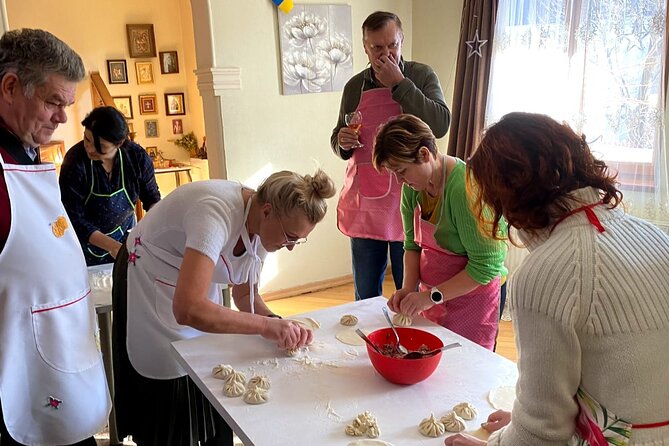
The setting matters. Instead of spending the entire evening in a commercial kitchen, you are taken to a local family home. That makes the experience feel more like an invitation to dinner. It also means the pace is less formal. The guide helps with the cooking, but there is room to talk about daily life in Georgia and ask questions.
At $49 per person, the value comes from the amount packed into the evening. You receive transport to the house, instruction, six foods, cheese, wine, chacha, water, and the meal you prepare. If you tried to buy a similar spread and drinks separately, the price would still be reasonable. The real benefit is the time spent cooking and talking in a private home.
A few more ways to spend a day out of Tbilisi
- Tbilisi:Mtskheta,Jvari,Bazaar,wine tasting,Chronicles of Georgia
★ 5.0 · 730 reviews - Old Tbilisi Tour: Private Walking Tour With Wine Tasting
★ 5.0 · 273 reviews - Private Tbilisi Food Tour: 9 Tastings Walk in Bohemian District
★ 5.0 · 227 reviews
Starting at Traveler’s Meeting Point
The meeting point is Traveler’s Meeting Point in Tbilisi, a free space with board games, music, and wine. You have about 30 minutes here before heading to the cooking portion.
This first stop gives the guide a chance to gather the group and explain the evening. It is also a useful pause if you arrive early. The space is designed for socializing, so solo visitors should not feel stranded while waiting for the group to form.
Still, this is not the main attraction. Think of it as a meeting lounge, not a full sightseeing stop. If you are hoping for an extended city tour, this experience may not fit that wish. The advertised program centers on food and family hospitality.
The tour begins at 6 p.m., so you should allow time to reach Avlabari in advance. A mobile ticket is accepted, and confirmation is provided when you book. Since the tour operates in all weather, dress for the forecast rather than assuming the evening will stay mild.
The ride to a family kitchen
Transport from the meeting point to the local home is included. This removes one of the evening’s awkward parts, especially if you are unfamiliar with Tbilisi’s neighborhoods.
The home is at 45 Gigo Zaziashvili Street, and the tour finishes there. One account describes taking a taxi with the guide to a house in the suburbs, which gives you a useful picture of the transition: after meeting in a central social space, you head out to a more residential setting for the meal.
Do not confuse the included ride with a round-trip transfer. Transportation from the family home is not included. Before the class begins, ask the guide about the best way back and keep enough phone battery for maps or a taxi booking.
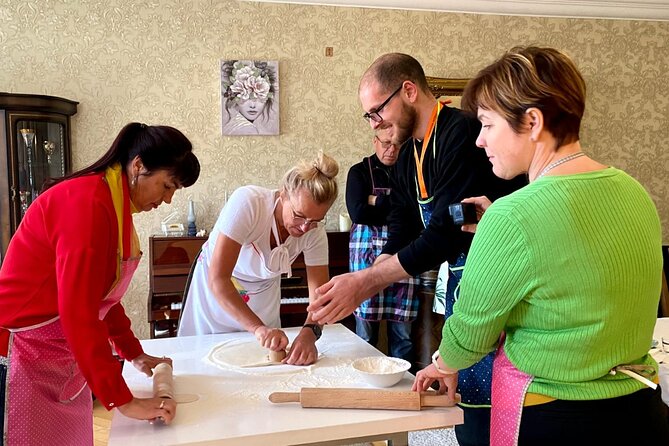
The group can reach a maximum of 30 people. That is a fairly large ceiling for a home-based class. The actual feel may depend on the number booked that evening. In a smaller group, you can expect more direct help with shaping dough and folding dumplings. In a larger group, you may spend more time watching others work.
Making six Georgian dishes by hand
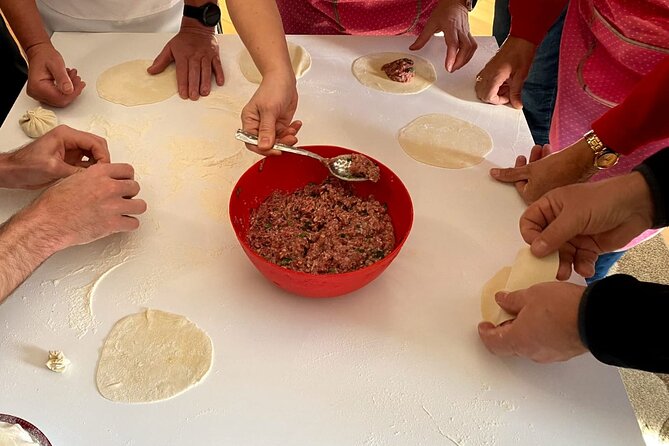
The cooking session lasts about two and a half hours. That is a substantial amount of time, and the menu explains why. You are not simply shown one recipe and handed a plate. You work through several classic Georgian foods.
A completely different kind of day out of Tbilisi:
- Day Trip to Kakheti Wine Region Including 9 Wine Tastings
★ 5.0 · 2,774 reviews - Highlights of Caucasus Mountains-Jinvali,Ananuri,Gudauri,Kazbegi(Group tour)
★ 5.0 · 2,682 reviews - Day Trip to Kazbegi and Gudauri
★ 5.0 · 2,009 reviews - Day Trip to Mtskheta Gori and Uplistsikhe
★ 5.0 · 1,801 reviews
Cucumber and tomato salad
This is a simple beginning, built around vegetables rather than elaborate technique. Georgian salad is commonly served fresh and often benefits from herbs or walnuts, though the exact preparation can vary.
For you, this dish offers a break from the heavier items later. It also shows how a Georgian meal may balance rich cheese and dough with something crisp and fresh.
Eggplant rolls with walnuts
Eggplant with walnut filling is one of the most distinctive items on the menu. The eggplant is prepared as rolls and paired with a walnut mixture, creating a soft texture and a rich, savory taste.
This is a good dish for vegetarians, and it gives you a useful introduction to the importance of walnuts in Georgian cooking. If you enjoy the dish, the recipe should be easy to recreate at home compared with the more demanding dumplings.
Mchadi
Mchadi is Georgian cornbread, traditionally eaten with beans and cheese. It is plain, filling, and practical food, with the corn flavor providing a change from wheat-based breads.
You will also have Sulguni, a mild, semi-firm Georgian cheese. Together, mchadi and Sulguni make a satisfying combination. The cheese is also important because it gives you a direct taste of a basic ingredient used in Georgian meals.
Khinkali
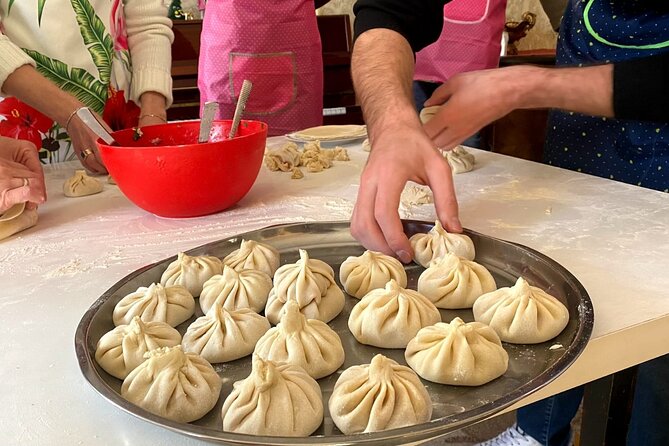
Khinkali are Georgian dumplings, and making them is likely to be the most playful part of the class. You form the dough, add the filling, and fold the top into the familiar pleated shape.
The finished dumplings are usually eaten with care because they contain hot juices. A practical tip is to hold one by its top knot, take a small bite, and sip the broth before eating the rest. The class gives you a chance to practice the shape without the pressure of ordering perfectly formed dumplings in a restaurant.
Vegetarian khinkali can be arranged upon request. One participant also received both beef and cheese khinkali because of a pork restriction, so it is worth explaining dietary needs before the day of the tour. Do not wait until the cooking begins.
Khachapuri
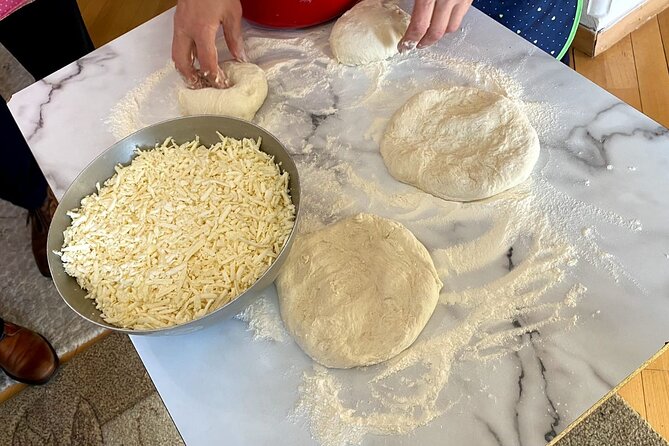
Khachapuri is cheese-filled bread and one of Georgia’s great comfort foods. It is substantial, soft, salty, and best eaten warm.
The class helps you see why this dish can take time. You are preparing bread and cheese as part of a larger meal, not grabbing a quick snack. Save room for it, but do not expect to finish everything easily. The food portions are described as generous, and the full menu can be more than one person needs.
Eating your own work with wine and chacha
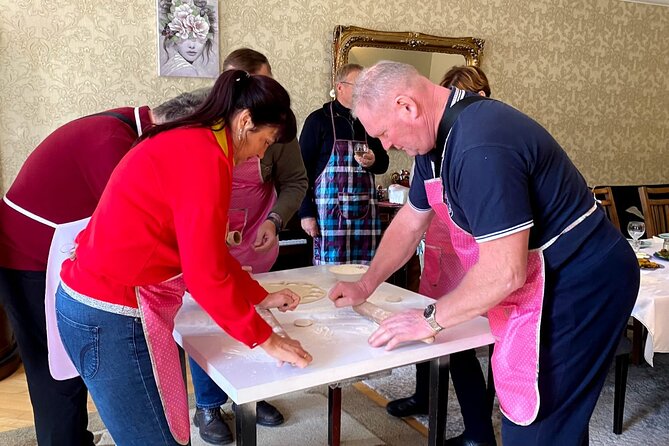
After cooking, you sit down to eat the food you prepared. This is where the class becomes a shared dinner rather than a demonstration.
The included drinks are homemade dry white wine, homemade chacha, and water. Chacha is Georgia’s famous grape vodka, and it is considerably stronger than ordinary table wine. Try a small amount first, especially if you plan to walk or arrange transport afterward.
The wine and chacha add cultural context, but you do not need to drink either one. If you prefer nonalcoholic options, water is included. The key value is that the drinks are part of the meal and not an unexpected supplement to the advertised price.
The food also gives the evening a natural rhythm. You cook, taste, compare results, and talk. Guides have been praised for making the atmosphere friendly and relaxed, with Tornike in particular described as bringing plenty of energy and humor. Beka and Buta have also helped explain the food and the wider story of Georgia while keeping the class practical.
The experience can work well for solo visitors. One person who joined alone felt included in a small group and appreciated receiving recipes afterward. That is an important detail if you are worried about arriving without a companion. Cooking gives everyone something to do, so conversation does not depend on already knowing the people beside you.
What makes the family setting worthwhile
A restaurant can show you what Georgian food tastes like. A family kitchen shows you how it fits into everyday hospitality.
You get to watch a local cook prepare dishes in a personal setting, ask questions while the food is being made, and see the meal come together from start to finish. The atmosphere is less polished than a formal cooking school, but that is part of the appeal. You are there for contact and participation, not a staged performance.
Recipes are another useful benefit. If the guide or family provides them, you can try the dishes again at home. Khachapuri and salad are approachable starting points. Khinkali takes more practice, but making it once gives you a much better understanding of the process.
There is also time to discuss life in Georgia. This conversation may be one of the strongest parts of the evening because it turns a food lesson into a cultural exchange. Guides including Helen, Beka, Buta, Toko, and Tornike have been singled out for friendliness, clear help, and good conversation.
The one limitation is consistency. A home class can vary with the guide, group size, and household pace. The operator has a strong overall record, but a 30-person maximum means you should not assume every session will feel intimate.
Who will enjoy this tour most
I would recommend this experience if you want a social evening with plenty of food and some practical cooking skills. It suits couples, solo visitors, food-focused visitors, and anyone who wants a local setting rather than another restaurant meal.
It is also a good choice for people who enjoy learning by doing. You will not simply watch a chef work. You will handle dough, fillings, vegetables, cheese, and bread, then eat the finished meal.
Families and groups with mixed food interests may also find it useful, provided everyone is comfortable with the late start and the alcohol-centered tasting. Vegetarian khinkali is available by request, but you should communicate dietary needs ahead of time.
I would be more cautious if you want a small, quiet class with a fixed end time. The food preparation is extensive, the portions are large, and conversation can stretch the evening. It is a relaxed home meal, not a quick two-hour activity.
Practical details that affect your evening
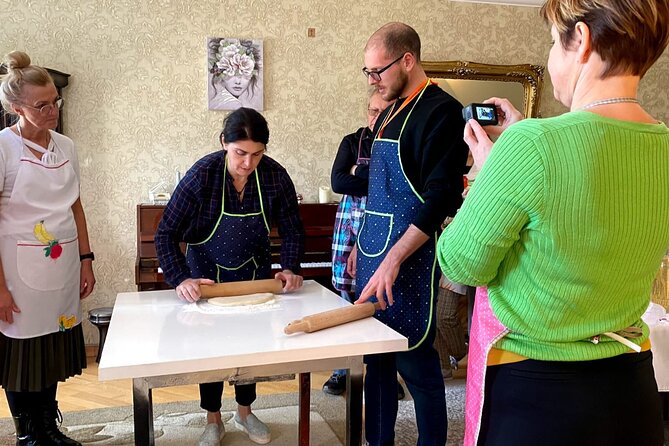
The price is $49 per person. That includes the guide, transport to the home, cooking instruction, six foods, wine, chacha, and water. Since you also eat the finished dishes, the cost is fair for an evening meal plus a class.
The tour lasts approximately three hours, though the cooking section alone takes about two and a half hours. Start time is 6 p.m., and the evening ends at the family home rather than at the original meeting point.
The activity is offered in English. Most people can participate, and it operates in all weather. Wear clothing suitable for the forecast and for working around food. Comfortable clothes are more useful than anything formal.
Free cancellation is available if you cancel at least 24 hours before the start time. Cancellations or changes made inside that window are not refunded or accepted. Gratuities for the guide are not included, so carry a little extra if you feel the service deserves thanks.
Should you book the Tbilisi family cooking tour?
Book it if you want a generous Georgian meal, a real cooking task, and an evening shaped by conversation. The strongest reasons are the family-home setting, the six-dish menu, the included wine and chacha, and the chance to take recipes home.
Skip it if you want a short tasting, guaranteed small-group instruction, or a central return transfer. The menu is heavy, the evening starts late, and you need to arrange your own way back from 45 Gigo Zaziashvili Street.
For most food-focused visitors, the $49 price is a good deal. You leave with a full stomach, a better grasp of Georgian cooking, and the memory of making your own khinkali and khachapuri instead of simply ordering them.
FAQ
How much does the Tbilisi family food tour cost?
The tour costs $49 per person. The price includes the guide, cooking classes, six foods, transport to the family home, homemade wine, chacha, and water.
How long does the experience last?
The total experience lasts approximately three hours. The meeting point visit takes about 30 minutes, and the cooking session takes about two and a half hours.
What time does the tour start?
The tour starts at 6 p.m.
Where does the tour begin?
It begins at Traveler’s Meeting Point in Avlabari, Tbilisi, Georgia.
Where does the tour finish?
The tour finishes at the local family home at 45 Gigo Zaziashvili Street, Tbilisi 0102, Georgia.
Is transportation included?
Transportation from the meeting point to the local family home is included. Transportation after the tour is not included.
What foods will I prepare and eat?
The menu includes cucumber and tomato salad, Georgian eggplant rolls with walnuts, mchadi cornbread, Sulguni cheese, khinkali dumplings, and khachapuri cheese-filled bread.
Is vegetarian khinkali available?
Yes. Vegetarian khinkali is available upon request, so you should make the request before the tour.
Can I cancel for a full refund?
Yes, if you cancel at least 24 hours before the experience begins. Cancellations or changes made less than 24 hours before the start time are not refunded or accepted.
Recently added around Tbilisi
- Wild Georgia 4WD PACK Adventure through Kakheti and Kazbegi 2in1★ 5.0 · 3 reviews
- Northern Armenia Highlights Tour from Tbilisi★ 5.0 · 3 reviews
- Kakheti wine region – Private Tour★ 5.0 · 3 reviews
- Private Full Day Trip to Kazbegi Mountains★ 5.0 · 3 reviews
- Kakheti With Top Destinations★ 5.0 · 3 reviews
- Jvari monastery & Mtskheta – Half day group tour from Tbilisi★ 5.0 · 3 reviews
- Borjomi – Rabati -Vardzia Private Full Day Tour from Tbilisi★ 5.0 · 3 reviews
- Private Effortless transfer from Tbilisi to Gudauri ski resort★ 5.0 · 3 reviews
Food & Drink, compared.
Mtskheta,Jvari,Bazaar,wine tasting,Chronicles of Georgia
Read our review →
Old Tbilisi Tour: Private Walking Tour With Wine Tasting
Read our review →
Private Tbilisi Food Tour: 9 Tastings Walk in Bohemian District
Read our review →
Private Wine Tasting in Prince Karalashvili Wine Cellar. Tbilisi
Read our review →
Private Tour From Tbilisi to Kakheti Sighnaghi with Wine Tasting
Read our review →
Adventure in Kakheti – Bodbe, Sighnaghi, wine tasting (Private Experience)
Read our review →
Private Kakheti Tour organic Wine Tasting with Lunch
Read our review →
Highlights of Kakheti region-Signagi,Bodbe,Wine tasting(Private Tour)
Read our review →Browse the lists this tour appears in