Reviewed · TBILISI TOURS
Brutal Tbilisi: Urban exploration and untold stories
Concrete has a story to tell. Brutal Tbilisi takes you far beyond the old town to see Soviet-era buildings, monumental art, refugee housing, abandoned architecture, and striking city views. I like the way the tour connects design with everyday Georgian life, and I like that guides such as Alex, Khato, Khatuna, and Aleksi bring plenty of historical context rather than simply pointing at buildings.
The main thing to consider is the pace and setting. This is a four-hour outing built around driving, walking, stairs, uneven ground, and buildings that may feel rough or austere. It suits adults who enjoy architecture and modern history far more than anyone seeking polished interiors or a relaxed sightseeing loop.
The tour costs $75 per person, includes bottled water and a local guide, and is recommended by 100 percent of its 59 ratings, with a 5.0 score. That is not a guarantee of perfection, but it does suggest unusually strong consistency.
In This Review
- Key Points About Brutal Tbilisi
- Why This Is a Different Tbilisi Tour
- Starting at Rose Revolution Square
- Ministry of Highways: Tbilisi’s Concrete Landmark
- Chronicles of Georgia and Monumental Storytelling
- The Former Archaeology Museum: An Unsettling Stop
- Maglivi Bridge and the Human Side of Soviet Planning
- Nutsubidze Skybridge and the Famous Elevator Ride
- What the Guides Add to the Experience
- Is $75 a Fair Price?
- Who Should Book This Four-Hour Tour?
- Booking Details Worth Knowing
- Should You Book Brutal Tbilisi?
- FAQ
- How long does Brutal Tbilisi last?
- How much does the tour cost?
- Where does the tour start and finish?
- Is hotel pickup available?
- What language is the tour offered in?
- Is lunch included?
- Is the tour suitable for children?
Key Points About Brutal Tbilisi
- The Ministry of Highways building is the visual star for many architecture fans, with huge concrete forms, sharp angles, and layered geometric shapes.
- The Chronicles of Georgia combines monumental sculpture with views over Tbilisi Reservoir and stories from Georgian history and mythology.
- The Former Archaeology Museum adds an eerie, abandoned quality that you will not find on a standard city tour.
- Nutsubidze Skybridge lets you cross elevated walkways between apartment towers, with a possible meeting with the local elevator operator.
- The tour links architecture to real lives, including former student housing now used by displaced people from Abkhazia.
- The small-group format and adjustable pace make it easier to ask questions, take photographs, or spend longer at a favorite site.
Why This Is a Different Tbilisi Tour
Tbilisi is often introduced through its old town, sulfur baths, churches, balconies, and steep lanes. Those places deserve your time, but they show only one chapter of the city. Brutal Tbilisi shifts attention to the Soviet and post-Soviet city, where grand public projects sit beside ordinary apartment blocks and signs of economic change.
I like this approach because the buildings are not treated as isolated curiosities. Your guide explains who designed them, why they were built, and what they mean now. A concrete dormitory is not just a concrete dormitory. It can also tell you about student life, displacement, government planning, and the changing role of public buildings.
The tour is offered in English. Past departures have featured guides including Alex, Khato, Khatuna, Aleksi, Iona, and Xato. The strongest feedback consistently centers on their ability to explain Georgian history in clear, lively terms and to answer questions along the way. Alex, in particular, is praised for combining architecture with broader information about Georgia, while Khato and Khatuna are noted for their patience, humor, and ability to let people take their time.
One practical point matters here: the advertised highlights describe a group of no more than six, while the additional tour information lists a maximum of 14 participants. Confirm the expected group size when booking if a very small group is important to you.
A few more ways to spend a day out of Tbilisi
- Day Trip to Kakheti Wine Region Including 9 Wine Tastings
★ 5.0 · 2,774 reviews - Highlights of Caucasus Mountains-Jinvali,Ananuri,Gudauri,Kazbegi(Group tour)
★ 5.0 · 2,682 reviews - Day Trip to Kazbegi and Gudauri
★ 5.0 · 2,009 reviews
Starting at Rose Revolution Square
The standard meeting point is the Giant Bicycle monument at Rose Revolution Square. The tour ends back at this meeting point, so plan your onward transport accordingly.
Private tours offer hotel pickup. The regular option does not include hotel pickup, so you will need to reach the starting point yourself. Tbilisi has public transportation nearby, and the meeting point is central enough to work well as the first stop of a day exploring the city.
Most of the four hours are spent moving between sites by vehicle and getting out to walk around. This is not a full-day excursion, but it is more than a quick photo drive. The listed visits add up to about three hours, leaving time for transport and conversation.
Ministry of Highways: Tbilisi’s Concrete Landmark
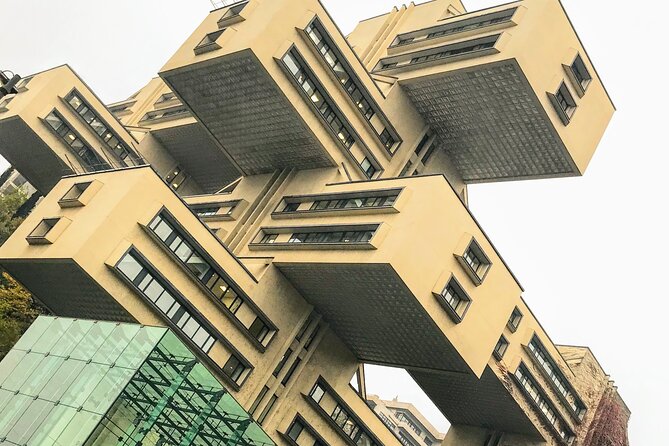
The first major stop is the former Ministry of Highways of the Georgian SSR, now associated with the Bank of Georgia building. It is one of Tbilisi’s best-known examples of brutalist architecture, and it makes a strong opening statement.
The building is formed from stacked, interlocking concrete sections. Its heavy mass looks almost impossible to balance, yet the design has a clear rhythm. Large blocks create shade and depth, while repeated lines and angles keep the structure from feeling like a plain concrete box.
You will spend about 30 minutes here, with free admission. That time is enough to take in the shape, hear the architectural background, and photograph the building from different angles without rushing through the explanation.
This is a good place to listen for the distinction between brutalism and simple neglect. Brutalist buildings use exposed concrete and bold structure as part of their design. The style can feel severe, but it can also be sculptural and carefully composed. A strong guide helps you see both sides.
The drawback is that exterior architecture can be hard to appreciate if the weather is poor or if you prefer interior access. The tour is about understanding the building as part of Tbilisi’s urban story, not entering every room.
Chronicles of Georgia and Monumental Storytelling
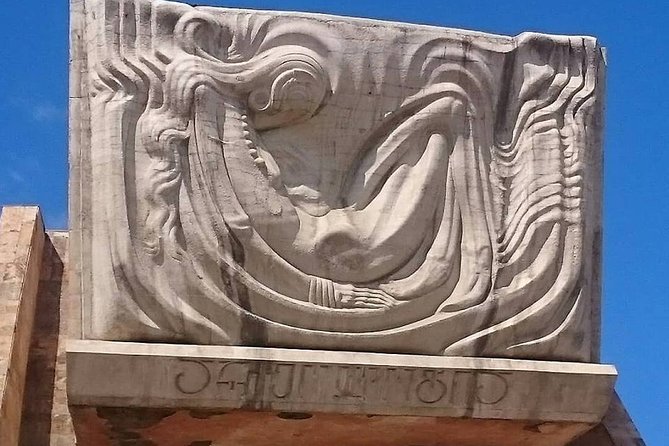
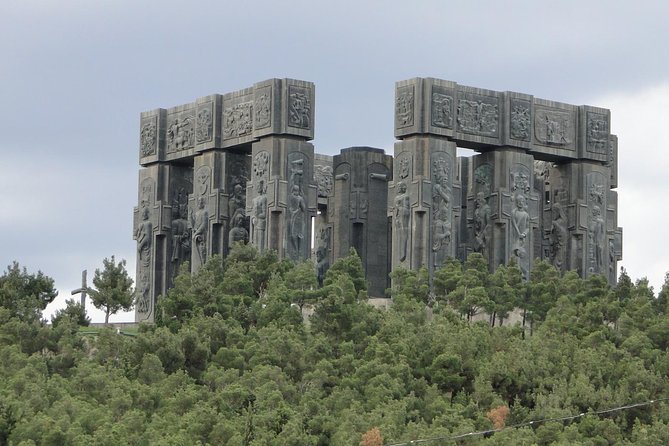
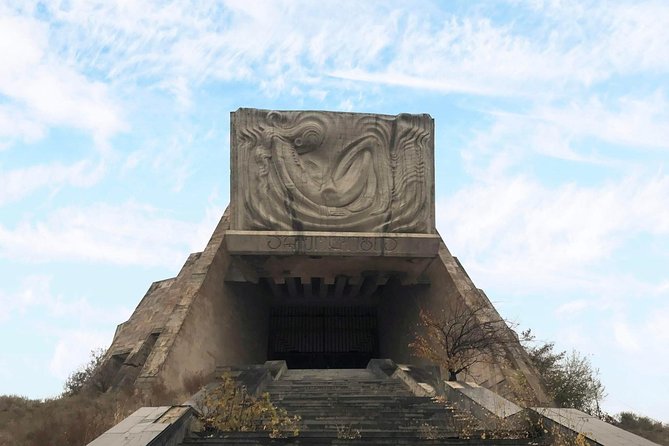
From the city center, the tour continues to the Chronicles of Georgia, also called the Memorial History of Georgia. The monument rises on a hill above Tbilisi and uses huge stone pillars covered with carved scenes.
The panels refer to Georgian rulers, religious events, national struggles, mythology, and the country’s conversion to Christianity. Your guide helps make sense of the images, which can otherwise seem imposing but difficult to read. This is one of the places where the tour’s historical focus adds real value.
You get about 45 minutes here, with no admission charge. That gives you time to examine the reliefs, walk around the monument, and take in the broad views. The hilltop setting is a welcome change after the denser city streets.
I especially like the contrast between this monument and the Ministry of Highways building. One uses modern concrete geometry and the other uses monumental stone reliefs, yet both were designed to shape public memory. Together, they show how architecture and political ideas can work hand in hand.
Bring weather-appropriate clothing. The site is exposed, and the experience depends partly on being comfortable outdoors. You should also expect some walking on sloped ground.
A completely different kind of day out of Tbilisi:
- Day Trip to Mtskheta Gori and Uplistsikhe
★ 5.0 · 1,801 reviews - Tbilisi Walking Tour Including Cable Car and Traditional Bakery
★ 5.0 · 1,310 reviews - Day Trip to Armenia Including Homemade Lunch
★ 5.0 · 1,162 reviews - Kakheti Wine Region: Signagi and Bodbe Tour with 10 Wine Tastings
★ 5.0 · 1,019 reviews
The Former Archaeology Museum: An Unsettling Stop
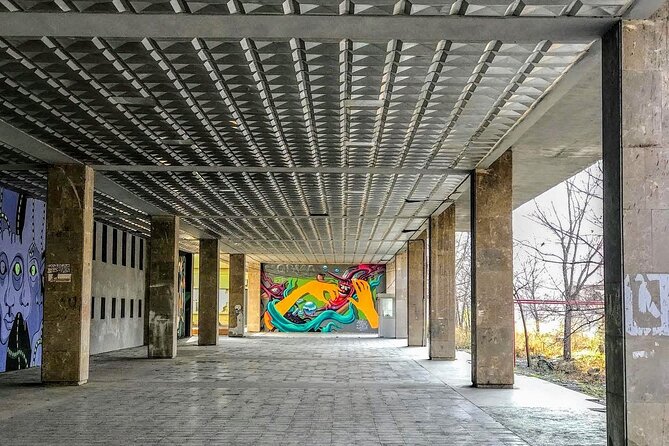
The Former Archaeology Museum is the tour’s strangest stop. Once a grand museum, it is now abandoned, giving the building an eerie atmosphere that sharply differs from the formal monuments earlier in the day.
You will spend roughly 30 minutes here. The appeal is not only the architecture but also the sense of a public institution that has lost its original purpose. It offers a glimpse into how buildings change when funding, politics, or public needs shift.
This stop is especially effective for people interested in urban exploration photography. Empty or deteriorating spaces can reveal details that polished museums hide: old construction methods, worn surfaces, large interior volumes, and traces of the building’s former role.
Access conditions may vary, so follow your guide’s instructions and do not assume every part of the structure is open or safe. The tour information describes the site as abandoned, not as a restored attraction with formal visitor facilities. You should be ready for a rougher experience and avoid treating it like a conventional museum visit.
For some people, this will be the highlight. For others, it may feel too bleak or basic. That difference comes down to your interest in abandoned places.
Maglivi Bridge and the Human Side of Soviet Planning
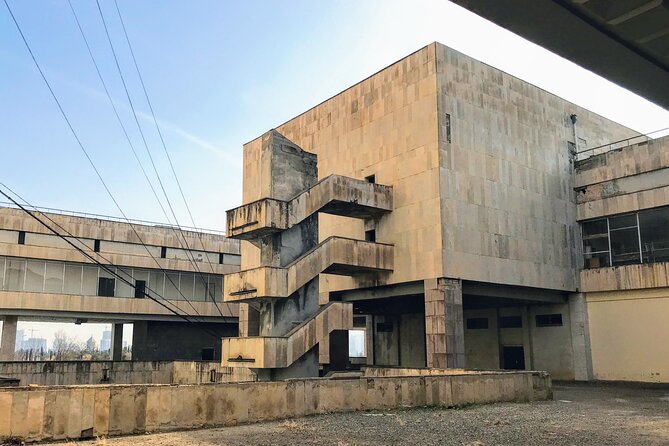
The Maglivi Bridge area adds an important social layer. Here you may see former student dormitories that now house displaced people, including refugees from Abkhazia.
This is where Brutal Tbilisi moves beyond visual appreciation. Soviet housing and education buildings were designed for one purpose, but later events changed how people use them. The buildings now tell a story about displacement and adaptation, not just concrete construction.
The tour also covers the old cable car in the university district. It once represented progress and modern transportation. Today, it is a reminder of a city moving from the Soviet period into a more uncertain present.
The visit lasts about 30 minutes. You may not find the same obvious photographic drama as at the skybridge, but the context is valuable. I would pay close attention to how your guide discusses the people connected with these buildings. The best part of this stop is its sensitivity.
This is also a point where respectful behavior matters. You are moving through areas connected to people’s homes and difficult personal histories. Keep photography discreet, listen to your guide, and remember that these are not empty sets built for tourists.
Nutsubidze Skybridge and the Famous Elevator Ride
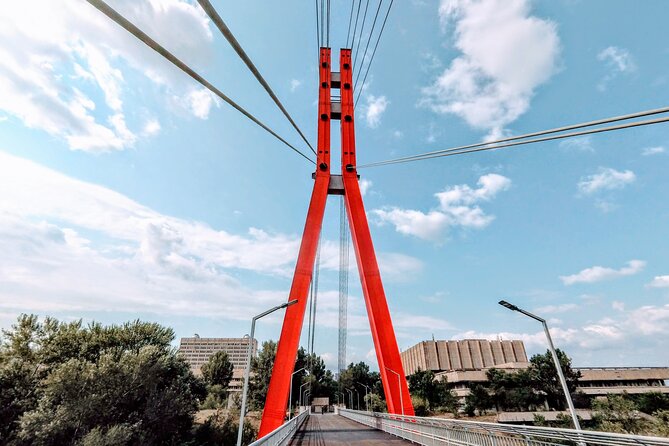
The Nutsubidze Skybridge is the tour’s most unusual architectural experience. Twin apartment towers are linked by elevated bridges, including walkways roughly 70 meters above the ground.
You may have the chance to cross one of these bridges and see Tbilisi from an angle that ordinary sightseeing rarely offers. The combination of apartment living, exposed concrete, and high-level walkways gives the area a memorable science-fiction quality, though the buildings are firmly rooted in late Soviet urban planning.
The scheduled visit lasts about 45 minutes. That is enough time to look at the towers, cross the bridge if access permits, and hear why the design was built this way. It also gives you room to take photographs without turning the stop into a hurried dash.
A recurring highlight is meeting the elevator operator, often described as the lift lady. She is part of the living character of the building, and this small human encounter can make the architecture feel less like an abstract design exercise.
You should be comfortable with heights and with using older building infrastructure. The tour does not promise that every bridge or interior area will always be accessible, so conditions may affect what you can see. Still, this is likely to be the most memorable stop for anyone who enjoys unusual apartment design.
What the Guides Add to the Experience
The guide is central to the value of this tour. Without explanation, some of the sites could look like large concrete structures, abandoned buildings, or distant monuments. With the right guide, they become connected pieces of Georgian political, architectural, and social history.
The strongest departures have been led by guides such as Alex, Khato, Khatuna, and Aleksi. Alex is praised for his broad grasp of Georgian history and for taking people to places they would not normally find. Khato and Khatuna are noted for patience, humor, and a willingness to adjust the pace for photographs or older family members.
One four-star experience praised the guide’s subject knowledge but found that repeated answers such as like I told you made it harder to ask questions. That may have involved a language or communication issue, but it is worth noting because conversation is a large part of the tour. If you have a question, ask clearly and early, and speak up if an explanation was not clear.
The overall feedback is unusually strong, with a 5.0 rating from 59 ratings and a 100 percent recommendation figure. I would still remember that guide performance can vary from one departure to another, especially when several guides lead the experience.
Is $75 a Fair Price?
At $75 per person, this is not the cheapest way to spend four hours in Tbilisi. You are paying for transport between scattered sites, a specialist guide, bottled water, and access to places that are difficult to connect on your own.
The value is strongest if you care about modern architecture, Soviet history, photography, or urban change. Trying to visit the Ministry of Highways building, Chronicles of Georgia, Former Archaeology Museum, Maglivi Bridge, and Nutsubidze Skybridge independently would take planning, local transport, and a fair amount of research. You might reach the sites, but you would miss much of the meaning behind them.
The value is weaker if you want formal museums, major religious sights, or a gentle walking tour in central Tbilisi. Admission is free at the listed stops, so the fee is mainly for the guide, transport, organization, and interpretation.
Group discounts are available. Private tours include hotel pickup, which may make the higher private-tour price worthwhile if you want a more flexible day or need a specific pickup arrangement.
Who Should Book This Four-Hour Tour?
You should consider it if you:
- Enjoy brutalist, modernist, or Soviet architecture.
- Have already seen Tbilisi’s old town and want a different side of the city.
- Like abandoned buildings and unusual urban spaces.
- Want history connected to present-day life.
- Take photographs and appreciate time at each stop.
- Prefer a guide who can explain context rather than offer a quick list of facts.
You may want to skip it if you dislike rough buildings, exposed outdoor sites, heights, or topics connected to displacement and political change. It is also not designed mainly for young children. Children can attend with an adult, but a family-friendly tour may be a better choice for younger visitors.
A moderate level of physical fitness is recommended. Wear clothes suited to the current weather, comfortable footwear, and something suitable for walking on uneven or sloped surfaces.
Booking Details Worth Knowing
Confirmation is sent at booking. The ticket is valid only for the date and time selected, so check those details carefully.
You can cancel or reschedule for a full refund up to 24 hours before the start time. Changes made less than 24 hours before the tour are not accepted, and the local Tbilisi time controls the cutoff.
The tour is offered in English. It includes bottled water and a local guide, but lunch is not included. Since the experience lasts about four hours and covers several outlying areas, eat beforehand or plan food for afterward.
Should You Book Brutal Tbilisi?
Book it if you want Tbilisi to make sense beyond its postcard center. The Ministry of Highways building, Chronicles of Georgia, Former Archaeology Museum, refugee housing, old cable car, and Nutsubidze Skybridge create a strong sequence, moving from bold design to national memory and then to ordinary lives.
I would give this tour priority during a second day in Tbilisi, or after you have seen the old town and want something less familiar. The price is reasonable for a specialist outing with transport and interpretation, especially if you would otherwise struggle to reach these places.
Skip it only if your idea of sightseeing requires polished attractions and easy walking. For architecture fans, photographers, and curious adults, Brutal Tbilisi offers a rare look at the city’s Soviet and post-Soviet identity, with enough human detail to make the concrete matter.
FAQ
How long does Brutal Tbilisi last?
The tour lasts approximately four hours.
How much does the tour cost?
The listed price is $75 per person. Group discounts are available.
Where does the tour start and finish?
It starts at the Giant Bicycle monument at Rose Revolution Square in Tbilisi and ends back at the same meeting point.
Is hotel pickup available?
Hotel pickup is available only for private tours. The regular tour begins at the stated meeting point.
What language is the tour offered in?
The tour is offered in English.
Is lunch included?
No. Bottled water is included, but lunch is not.
Is the tour suitable for children?
Children may attend if accompanied by an adult, but the experience is designed primarily for adults. A family-friendly tour is recommended for visitors traveling with younger children.
Recently added around Tbilisi
- Northern Armenia Highlights Tour from Tbilisi★ 5.0 · 3 reviews
- Wild Georgia 4WD PACK Adventure through Kakheti and Kazbegi 2in1★ 5.0 · 3 reviews
- Kakheti wine region – Private Tour★ 5.0 · 3 reviews
- Private Full Day Trip to Kazbegi Mountains★ 5.0 · 3 reviews
- Kakheti With Top Destinations★ 5.0 · 3 reviews
- Jvari monastery & Mtskheta – Half day group tour from Tbilisi★ 5.0 · 3 reviews
- Private Effortless transfer from Tbilisi to Gudauri ski resort★ 5.0 · 3 reviews
- Borjomi – Rabati -Vardzia Private Full Day Tour from Tbilisi★ 5.0 · 3 reviews
Tbilisi Tours, compared.
Day Trip to Kakheti Wine Region Including 9 Wine Tastings
Read our review →
Highlights of Caucasus Mountains-Jinvali,Ananuri,Gudauri,Kazbegi(Group tour)
Read our review →
Tbilisi Walking Tour Including Cable Car and Traditional Bakery
Read our review →

Kakheti Wine Region: Signagi and Bodbe Tour with 10 Wine Tastings
Read our review →